Élasmobranches (requins et raies) (sharks and rays) >
Carcharhiniformes (Ground sharks) >
Pseudotriakidae (False catsharks)
Etymology: Gollum: Named for the antihero of Tolkien’s “Lord of the Rings” trilogy, to which G. attenuatus “bears some resemblance in form and habits” (See ETYFish); suluensis: -ensis, Latin suffix denoting place: Sulu Sea, Philippines, type locality (See ETYFish).
Eponymy: The genus and these species are named after the fictional character, Gollum, in J R R Tolkien’s The Hobbit and Lord of the Rings. [...] (Ref. 128868), visit book page.
More on authors: Last & Gaudiano.
Environnement : milieu / zone climatique / profondeur / gamme de distribution
Écologie
marin benthopélagique. Tropical
Distribution
Territoires | Zones FAO | Écosystèmes | Occurrences | Carte par point | Introductions | Faunafri
Known only from off Palawan Island (Philippines) in the western sector of the Sulu Sea basin; collected on the insular slope at about 730 m depth (Ref. 87759).
Taille / Poids / Âge
Maturité: Lm ? range ? - ? cm
Max length : 58.5 cm SL mâle / non sexé; (Ref. 87759)
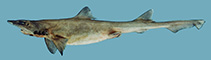
A small species of Gollum with the following combination of characters: body soft; head bell-shaped with a broadly parabolic snout; direct preorbital snout length 2.1–2.4 times eye length; preoral length 0.8–1.0 of mouth width, 1.3 times prenarial length; eye 1.4–1.5 times nostril length, more than 4.8 times spiracle length; head relatively broad, 12–14% TL; direct preorbital snout length 1.2–1.4 times interorbital space; head length 2.3–2.6 times mouth width, 8.0–9.0 times nostril width, 3.0–3.5 times preventral caudal-fin margin; length of pectoral-fin anterior margin 2.2–2.5 times its base; first dorsal-fin inner margin 0.5–0.6 of pectoral-fin base; second dorsal-fin base 10–12% TL; ventral head dusky, not strongly contrasted with dorsal surface along its lateral margin; posterior edges of dorsal fins not excessively concave; tips of dorsal fins dark; ventral margin of caudal fin dusky, not strongly contrasted with rest of fin; mouth dark; monospondylous centra 44–45, diplospondylous centra 107–109, total centra 151–154 (Ref. 87759).
Body shape (shape guide): elongated.
Cycle de vie et comportement reproducteur
Maturité | Reproduction | Frai | Œufs | Fécondité | Larves
Last, P.R. and J.P. Gaudiano, 2011. Gollum suluensis sp. nov. (Carcharhiniformes: Pseudotriakidae), a new gollumshark from the southern Philippines. Zootaxa 3002:17-30. (Ref. 87759)
Statut dans la liste rouge de l'IUCN (Ref. 130435: Version 2025-2 (Global))
Menace pour l'homme
Harmless
Utilisations par l'homme
Outils
Articles particuliers
Télécharger en XML
Sources Internet
Estimations basées sur des modèles
Indice de diversité phylogénétique (Réf.
82804): PD
50 = 0.7812 [Uniqueness, from 0.5 = low to 2.0 = high].
Bayesian length-weight: a=0.00174 (0.00069 - 0.00436), b=3.21 (2.99 - 3.43), in cm total length, based on LWR estimates for this (Sub)family-body shape (Ref.
93245).
Niveau trophique (Réf.
69278): 4.0 ±0.4 se; based on size and trophs of closest relatives
Vulnérabilité de la pêche (Ref.
59153): Moderate to high vulnerability (49 of 100).
🛈