>
Anguilliformes (Eels and morays) >
Protanguillidae (Protoanguillids)
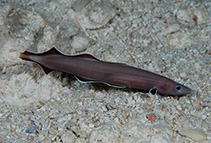
Etymology: Protanguilla: Name from the Greek 'protos' meaning first, and Latin 'anguilla' for eel; referring to the early divergence of the genus among anguilliforms; palau: Named for its type locality; noun in apposition (Ref. 87802).
Ambiente: milieu / zona climatica / distribuzione batimetrica / gamma di distribuzione
Ecologia
marino associati a barriera corallina; distribuzione batimetrica 35 - ? m (Ref. 87802). Tropical; 9°N - 6°N, 134°E - 135°E
Western Pacific: Republic of Palau. Presently known from a western fringing reef of Ngemelis Island, in a reef cave at 35 m depth. As an elopomorph, it almost certainly has a leptocephalus larval form, and letptocephali (particularly those of anguilliforms) are known to have long planktonic durations (2-10 months). Accordingly, the authors believe that Protoanguilla probably has a considerably broader distribution than currently known, even though no leptocephali matching its unique meristic formula (fewer than 90 vertebrae, more than 170 dorsal fin and anal fin rays) have been identified in extensive worldwide larval fish collections. In any case, historically, the Protoanguilla lineage, estimated to have diverged ca 200Ma, must have been much more widely distributed, because the Palau-Kyushu Ridge formed only around 60-70 Ma (Ref. 87802).
Dimensione / Peso / Età
Maturità: Lm ? range ? - ? cm
Max length : 17.6 cm TL (female)
Breve descrizione
Chiavi di identificazione | Morfologia | Morfometria
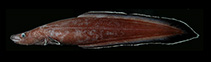
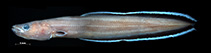
Gill opening terminates as ovoid tube with low, fringed collar; pseudobranch present; knob-like, toothed gill rakers present; premaxilla present, autogenous; symplectic autogenous; metapterygoid present; anterior end of vomer with small, ovoid, autogenous toothplate; body relatively short, total vertebrae 87 or fewer (79–87, mean ¼ 83.3); hypurals 3 and 4 not fused to each other; pterosphenoid not excluded from posterior margin of orbit (Ref. 87802).
Body shape (shape guide): eel-like.
Cave species (Ref. 87802).
Ciclo vitale e comportamento di accoppiamento
Maturità | Riproduzione | Deposizione | Uova | Fecondità | Larve
Johnson, G.D., H. Ida, J. Sakaue, T. Sado, T. Asahida and M. Miya, 2012. A 'living fossil' eel (Anguilliformes: Protanguillidae, fam. nov.) from an undersea cave in Palau. Proc. Royal Soc. B 279(1730):934-943. (Ref. 87802)
Stato della Lista Rossa IUCN (Ref. 130435: Version 2025-2 (Global))
Minaccia per l'uomo
Harmless
Usi umani
Strumenti
Rapporti speciali
Scarica XML
Fonti Internet
Stime basate su modelli
Indice di diversità filogenetica (Fonte Biblio.
82804): PD
50 = 1.5000 [Uniqueness, from 0.5 = low to 2.0 = high].
Bayesian length-weight: a=0.00102 (0.00046 - 0.00225), b=3.06 (2.88 - 3.24), in cm total length, based on all LWR estimates for this body shape (Ref.
93245).
Livello trofico (Fonte Biblio.
69278): 3.5 ±0.6 se; based on size and trophs of closest relatives
Vulnerabilità della pesca (Ref.
59153): Low vulnerability (10 of 100).
🛈