Klassifizierung / Names
Namen | Synonyme | Catalog of Fishes(Gattung, Arten) | ITIS | CoL | WoRMS | Cloffa
>
Perciformes/Serranoidei (Groupers) >
Anthiadidae (Fairy basslets or Streamer basses)
Etymology: Odontanthias: Greek, odous = teeth + Greek, anthis = a fish, Sparus aurata (Ref. 45335); randalli: Named after John E. Randall, who has made such a significant contribution to the knowledge of anthiine fishes, and Indo–Pacific fishes in general. The review of the Odontanthias genus he co-authored provided detailed description of the nominal species and their relationships with closely related genera (Ref. 87803).
Eponymy: Dr John ‘Jack’ Ernest Randall Jr. [...] (Ref. 128868), visit book page.
Umwelt: Milieu / Klimazone / Tiefenbereich / Verbreitungsgebiet
Ökologie
seewasser benthopelagisch. Tropical; 8°S - 9°S
Indo-Pacific: Indonesia. Tanjung Luar fish landing site, Lombok, East Nusa Tenggara (Ref. 87803).
Größe / Gewicht / Alter
Geschlechtsreife: Lm ? range ? - ? cm
Max length : 21.2 cm SL Männchen/unbestimmt; (Ref. 87803)
Kurzbeschreibung
Bestimmungsschlüssel | Morphologie | Morphometrie
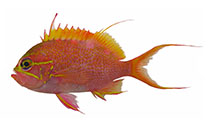
Rückenflossenstacheln (insgesamt) : 10; Rückenflossenweichstrahlen (insgesamt) : 16 - 17; Afterflossenstacheln: 3; Afterflossenweichstrahlen: 7. Body depth 2.2–2.5 in SL; spine at angle of preopercle moderately long, extending about half distance to margin of subopercle; vomerine tooth patch arrowhead-shaped; no teeth on mesopterygoids; scales dorsally on snout nearly reaching upper lip; 3rd dorsal spine elongate, 1.36–2.32 in head length; 3rd ray of dorsal fin the longest, greatly produced as a long filament; 2nd anal spine subequal to third, 2.32–2.78 in head length; caudal fin lunate, the lobes very long and filamentous, fin length 1.37–2.01 in SL. Colour when fresh mostly pink; scales on upper half of body each with a bright yellow spot; head pinkish with a vivid yellow, horizontal V-shaped marking originating on snout tip and extending posteriorly as two stripes; lower stripe running posteroventrally below eye to edge of opercle; upper stripe running posterodorsally through about the middle of eye to edge of the opercle just above primary opercular spine; nape yellowish; four pale pinkish blotches present below dorsal fin base; dorsal fin mostly yellow with some pink areas; anal fin pinkish with yellow pigment between second and third spines extending on to posterior portion of posteriorly adjacent fin membranes; caudal fin mostly pink with yellow pigment basally and extending along centre of filamentous lobes; pectoral fins pinkish with yellow stripe on anterior third extending from base of fin to about one-third distance of longest rays; pelvic fin mostly pink with yellow pigment on membrane between first and second soft rays (Ref. 87803).
Body shape (shape guide): fusiform / normal.
Lebenszyklus und Paarungsverhalten
Geschlechtsreife | Fortpflanzung | Ablaichen | Eier | Fruchtbarkeit | Larven
White, W.T., 2011. Odontanthias randalli n. sp., a new anthiine fish (Serranidae: Anthiinae) from Indonesia. Zootaxa 3015:21-28. (Ref. 87803)
IUCN Rote Liste Status (Ref. 130435: Version 2025-2 (Global))
Bedrohung für Menschen
Harmless
Nutzung durch Menschen
Tools
Zusatzinformationen
Download XML
Internet Quellen
Schätzungen auf der Grundlage von Modellen
Phylogenetischer Diversitätsindex (Ref.
82804): PD
50 = 0.5000 [Uniqueness, from 0.5 = low to 2.0 = high].
Bayesian length-weight: a=0.01413 (0.00621 - 0.03212), b=3.00 (2.81 - 3.19), in cm total length, based on LWR estimates for this (Sub)family-body shape (Ref.
93245).
Trophische Ebene (Ref.
69278): 3.4 ±0.4 se; based on size and trophs of closest relatives
Widerstandsfähigkeit (Ref.
120179): mittel, Verdopplung der Population dauert 1,4 - 4,4 Jahre. (Preliminary K or Fecundity.).
Anfälligkeit der Fischerei (Ref.
59153): Low vulnerability (16 of 100).
🛈