Klassifizierung / Names
Namen | Synonyme | Catalog of Fishes(Gattung, Arten) | ITIS | CoL | WoRMS | Cloffa
>
Cyprinodontiformes (Rivulines, killifishes and live bearers) >
Nothobranchiidae (African rivulines)
Etymology: Aphyosemion: Greek, aphye, -es, sardine, anchovy + Greek, semeion = mark, signal (Ref. 45335).
More on author: Myers.
Umwelt: Milieu / Klimazone / Tiefenbereich / Verbreitungsgebiet
Ökologie
; süßwasser benthopelagisch. Tropical
Africa: right bank of the Congo River in Republic of Congo and Democratic Republic of the Congo (Ref. 86918), including Pool Malebo, the Alima, Aruwimi and Tshopo rivers (Ref. 86918). Reports from the Tshuapa, Lomela and Salonga questionable, possibly representing a new species (Ref. 86918).
Größe / Gewicht / Alter
Geschlechtsreife: Lm ? range ? - ? cm
Max length : 3.4 cm SL Männchen/unbestimmt; (Ref. 87850)
Kurzbeschreibung
Bestimmungsschlüssel | Morphologie | Morphometrie
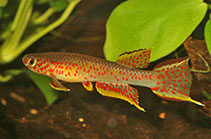
This species can be separated from its congeners by the red band in the anal fin and by the very dark red border on the dorsal and caudal fins (Ref. 87849). The body is blue colored with no more than 50 red points (Ref. 87849).
Body shape (shape guide): fusiform / normal.
Lebenszyklus und Paarungsverhalten
Geschlechtsreife | Fortpflanzung | Ablaichen | Eier | Fruchtbarkeit | Larven
van der Zee, J.R. and J.H. Huber, 2006. Zur Identität von Aphyosemion christyi (Boulenger, 1915), Aphyosemion schoutedeni (Boulenger, 1920), und Aphyosemion castaneum Myers, 1924. (Pisces, Cyprinodontiformes, Aplocheilidae). DKG-J. 38(5):131-142. (Ref. 87849)
IUCN Rote Liste Status (Ref. 130435: Version 2025-2 (Global))
Bedrohung für Menschen
Harmless
Nutzung durch Menschen
Tools
Zusatzinformationen
Download XML
Internet Quellen
Schätzungen auf der Grundlage von Modellen
Phylogenetischer Diversitätsindex (Ref.
82804): PD
50 = 0.5000 [Uniqueness, from 0.5 = low to 2.0 = high].
Bayesian length-weight: a=0.01096 (0.00461 - 0.02608), b=2.94 (2.74 - 3.14), in cm total length, based on LWR estimates for this (Sub)family-body shape (Ref.
93245).
Trophische Ebene (Ref.
69278): 3.2 ±0.4 se; based on size and trophs of closest relatives
Anfälligkeit der Fischerei (Ref.
59153): Low vulnerability (10 of 100).
🛈