分類 / 名前
共通名の | 類義語 | Catalog of Fishes(部類, 種) | ITIS | CoL | WoRMS | Cloffa
>
Siluriformes (Catfishes) >
Trichomycteridae (Pencil or parasitic catfishes) > Glanapteryginae
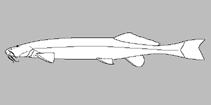
Etymology: Pygidianops: Greek, pyge = rump + Gree, ops = appearance (Ref. 45335); amphioxus: The specific name, a noun in apposition, refers to the cephalochordate amphioxus (a common name that applies to Recent cephalochordates in general, now mostly included in the genus Branchiostoma), in allusion to obvious similarities in body shape and superficial aspect (Ref. 87858).
環境:環境 / 気候帯 / 深さの範囲 / 分布範囲
生態学
; 新鮮な水 底生の漂泳性. Tropical; 0°S - 4°S, 56°W - 65°W
South America: Brazil. Pygidianops amphioxus has the broadest reported distribution of any glanapterygine species yet known, spanning over 900 km in straight line. Its westernmost record is the rio Daraá, tributary of the upper rio Negro, and its eastern limit is an affluent to the rio Nhamundá, a northern Amazonian tributary just west of the rio Trombetas. Within the Ducke Preserve, the species occurs in igarapé do Acará and igarapé Tinga (Soares-Carvalho, 2010), which belong to two distinct systems. The igarapé do Acará opens on the rio Tarumã, which is a tributary to the lower rio Negro; while the igarapé Tinga is part of the rio Puraquequara which opens directly into the rio Amazonas. In all cases, P. amphioxus is restricted to lowland terra firme rivers on the northern Amazonian versant. This suggests some association with the Guiana Shield, a link further highlighted by the close relationship of P. amphioxus to P. magoi, from the río Orinoco. However, at this time it is premature to speculate further on the significance of that association. It is likely that current distributional data are still incomplete and that the species will be found in many other localities as suitable microhabitats are more thoroughly sampled (Ref. 87858).
サイズ / 重さ / 年齢
成熟: Lm ? range ? - ? cm
Max length : 3.0 cm SL オス/雌雄の選別がない; (Ref. 87858); 2.6 cm SL (female)
ライフサイクルと交尾行動
成熟 | 繁殖 | 放精 | 卵 | 生産力 | 幼生
de Pinna, M.C.C. and A.L. Kirovsky, 2011. A new species of sand-dwelling catfish, with a phylogenetic diagnosis of Pygidianops Myers (Siluriformes: Trichomycteridae: Glanapteryginae). Neotrop. Ichthyol. 9(3):493-504. (Ref. 87858)
IUCNのレッドリストの状況は (Ref. 130435: Version 2025-2 (Global))
人間の用途
用具
特記事項
XMLをダウンロードして下さい
インターネットの情報源
モデルに基づく推定値
系統多様性指数 (参照
82804): PD
50 = 0.5625 [Uniqueness, from 0.5 = low to 2.0 = high].
Bayesian length-weight: a=0.00389 (0.00180 - 0.00842), b=3.12 (2.94 - 3.30), in cm total length, based on all LWR estimates for this body shape (Ref.
93245).
栄養段階 (参照
69278): 3.1 ±0.3 se; based on size and trophs of closest relatives
漁業の脆弱性 (Ref.
59153): Low vulnerability (10 of 100).
🛈