การจำแนกประเภท / ชื่อ
ชื่อสามัญ | ชื่อพ้อง | Catalog of Fishes(สกุล, ชนิด) | ITIS | CoL | WoRMS | Cloffa
>
Gymnotiformes (Knifefishes) >
Rhamphichthyidae (Sand knifefishes)
Etymology: Gymnorhamphichthys: Greek, gymnos = naked + Greek. Rhamphos = beak, bill + Greek, ichthys = fish (Ref. 45335).
Eponymy: Dr Heraldo Antonio Britski is a Brazilian ichthyologist who was awarded a bachelor’s degree (1960) and a doctorate (1973) by Universidade de São Paulo where he is still a researcher, even though he is officially retired. [...] (Ref. 128868), visit book page.
สิ่งแวดล้อม : สิ่งแวดล้อม / เขตภูมิอากาศ / ระดับความลึก / ระยะการกระจายสินค้า
นิเวศวิทยา
; น้ำจืด กลุ่มสัตว์หน้าดิน,กลุ่มสัตว์พื้นท้องน้ำ. Tropical
South America: Paraguay. Gymnorhamphichthys britskii is known from tributaries of the Rio de La Plata system. It is known from the upper and lower Paraguay (Neris et al., 2010) basins in Paraguay and Brazil, and the lower Parana´ basin in Paraguay, Brazil, and Argentina (no records from Uruguay basin). The presence of this species in the Upper Parana was likely caused by the formation of the Itaipu reservoir, which allowed dispersal into upstream portions of the Parana through the former Sete Quedas waterfalls (Ref. 87956)
ขนาด / น้ำหนัก / อายุ
วัยเจริญพันธุ์: Lm ? range ? - ? cm
Max length : 18.0 cm SL เพศผู้/กระเทย; (Ref. 87956)
คำอธิบายสั้นๆ
เครื่องมือที่ใช้ในการแยกชนิดสัตว์,สิ่งมีชีวิตออกจากกัน | สัณฐานวิทยา | ความยาวต่างๆ
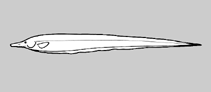
This species is distinguished from its congeners except G. hypostomus in having 5-16 (usually 9-13) large dark saddle-shaped pigment bars over the dorsal midline, extending between the nape and a vertical with the end of the anal fin, and sometimes reaching to or slightly below the lateral line; differs from G. hypostomus in having 141-172 (vs. 178-211) anal-fin rays; a shorter snout, preorbital distance 48.1-60.3% of head length (mean 54.6%) (vs. 58.3-68.6%, mean 63.9%); a larger eye, with diameter 5.7-9.0% of head length (mean 7.0%) (vs. 3.3-5.9%, mean 4.3%); a longer distance from tip of snout to posterior nares, 17.1-22.0% of head length (mean19.2%) (vs. 11.2-17.1%, mean 13.8%); 7 (vs. 9-13) displaced hemal spines; and 64-69 (vs. 71-75) vertebrae to end of anal fin (Ref. 87956).
วงจรชีวิตและพฤติกรรมการผสมพันธุ์
วัยเจริญพันธุ์ | การสืบพันธุ์ | การวางไข่ | เซลสืบพันธ์ของเพศเมีย(ไข่) | ความดกของไข่ | ตัวอ่อน
Carvalho, T.P., Ramos, C.S. and J.S. Albert, 2011. A new species of Gymnorhamphichthys (Gymnotiformes: Rhamphichthyidae) from the Paraná-Paraguay Basin. Copeia 2011(3):400-406. (Ref. 87956)
สถานะบัญชีแดงของ IUCN (Ref. 130435: Version 2025-2 (Global))
ภัยคุกคามต่อมนุษย์
Harmless
การใช้ของมนุษย์
เครื่องมือ
รายงานพิเศษ
ดาวน์โหลด XML
แหล่งที่มาจากอินเตอร์เน็ต
การประมาณค่าตามแบบจำลอง
ดัชนีความหลากหลายทางวิวัฒนาการ (อ้างอิง
82804): PD
50 = 0.5156 [Uniqueness, from 0.5 = low to 2.0 = high].
Bayesian length-weight: a=0.00269 (0.00105 - 0.00688), b=3.07 (2.85 - 3.29), in cm total length, based on LWR estimates for this (Sub)family-body shape (Ref.
93245).
ระดับชั้นอาหาร (อ้างอิง
69278): 3.2 ±0.4 se; based on size and trophs of closest relatives
ความเสี่ยงต่อการตกปลา (Ref.
59153): Low vulnerability (12 of 100).
🛈