>
Ovalentaria/misc (Various families in series Ovalentaria) >
Opistognathidae (Jawfishes)
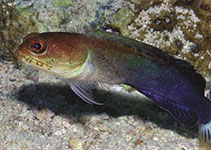
Etymology: Opistognathus: Greek, opisthe = behind + Greek, gnathos = jaw (Ref. 45335); to the very elongate upper jaw of the type species of the genus, Opistognathus nigromarginatus (Ref. 128653); albicaudatus: From the Latin albus (white) and cauda (tail). The suggested common name is whitetail jawfish (Ref. 88069).
Environnement : milieu / zone climatique / profondeur / gamme de distribution
Écologie
marin démersal; profondeur 25 - 30 m (Ref. 88069). Tropical; 12°N - 11°N, 93°E - 94°E
Eastern Indian Ocean: Andaman Islands.
Taille / Poids / Âge
Maturité: Lm ? range ? - ? cm
Max length : 9.5 cm SL mâle / non sexé; (Ref. 88069)
Description synthétique
Clés d'identification | Morphologie | Morphométrie
Épines dorsales (Total) : 11; Rayons mous dorsaux (Total) : 15; Épines anales: 3; Rayons mous anaux: 15. A species of Opistognathus with an elongate supramaxilla and maxilla whose posterior end is produced as a thin flexible lamina that in adults extends to or beyond rear margin of opercle; inner lining of upper jaw and adjacent membranes with one conspicuous black stripe; in life, caudal fin uniformly white; first gill arch with conspicuous, small dark blotches (8–11), each adjacent to a gill-raker base; dorsal fin XI, 15; body with about 72–75 oblique scale rows (Ref. 88069).
Body shape (shape guide): elongated; Cross section: oval.
Inhabits flat, current-swept (3+ knots) sand and rubble plain at approximately 25–30 m depth without coral growth but with an occasional low, stunted gorgonian sea fan present. Opistognathus cyanospilotus, previously known from the Andaman Sea and Bali but not from the Andaman Islands, occurs in the same environment as O. albicaudatus and was collected from four separate burrows (Ref. 88069).
Cycle de vie et comportement reproducteur
Maturité | Reproduction | Frai | Œufs | Fécondité | Larves
Smith-Vaniz, W.F., 2023. Review of Indo-West Pacific jawfishes (Opistognathus: Opistognathidae), with descriptions of 18 new species. Zootaxa 5252(1):1-180. (Ref. 128653)
Statut dans la liste rouge de l'IUCN (Ref. 130435: Version 2025-2 (Global))
Menace pour l'homme
Harmless
Utilisations par l'homme
Outils
Articles particuliers
Télécharger en XML
Sources Internet
Estimations basées sur des modèles
Indice de diversité phylogénétique (Réf.
82804): PD
50 = 0.5000 [Uniqueness, from 0.5 = low to 2.0 = high].
Bayesian length-weight: a=0.00389 (0.00180 - 0.00842), b=3.12 (2.94 - 3.30), in cm total length, based on all LWR estimates for this body shape (Ref.
93245).
Niveau trophique (Réf.
69278): 3.5 ±0.6 se; based on size and trophs of closest relatives
Vulnérabilité de la pêche (Ref.
59153): Low vulnerability (10 of 100).
🛈