>
Cypriniformes (Carps) >
Nemacheilidae (Brook loaches)
Etymology: himalaya: Name from the Sanskrit (of Hima-Alaya), meaning ‘adobe of snow’; referring to the Himalayan Mountain Range to which the species is endemic.
Meio ambiente: milieu / Zona climática / intervalo de profundidade / faixa de distribuição
Ecologia
; Água doce demersal. Subtropical
Asia: Koshi and Gandaki River basins in Nepal.
Tamanho / Peso / Idade
Maturidade: Lm ? range ? - ? cm
Max length : 5.9 cm SL macho/indeterminado; (Ref. 95092)
Descrição suscinta
Chaves de identificação | Morfologia | Morfometria
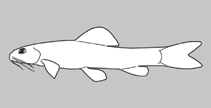
Vértebras: 42 - 43. Differs from its hypothesized congener, Turcinoemacheilus kosswigi, from the Euphrates, Tigris and Karoun basins of the Middle East, by the following characters: presence of small scales on the posterior half of its body (vs. absence of all scales); shorter caudal peduncle length 12-15% standard length (vs. 16-23); shorter snout length 28-36% head length (vs. 40-49); and color pattern, which includes the presence of small irregularly shaped dark grey markings over the lateral body surface (Ref. 88137).
Body shape (shape guide): elongated.
Specimens were collected from large rivers (>10 m width) and medium-sized (5-10 m wide) tributaries of the Koshi and Gandaki River systems of eastern and central Nepal. At the
type locality in the Koshi basin, the Indrawati River is a pristine, fast to torrential flowing river, over a cobble and boulder substratum, with a well-developed gravel shoreline. At this site, the species was collected close to shore, together with juveniles of Psilorhynchus pseudecheneis and an unidentified species of Schistura by sifting a dip net or small seine through gravel. In the Gandaki basin, specimens were collected (during each season of the year) in well-oxygenated, shallow riffles and runs with moderate to swift flow over clean, mainly pebble and cobble substratum (Ref. 88137).
Ciclo de vida ou comportamento de acasalamento
Maturidade | Reprodução | Desova | Ovos | Fecundidade | Larvas
Conway, K.W., D.R. Edds, J. Shrestha and R.L. Mayden, 2011. A new species of gravel-dwelling loach (Ostariophysi: Nemacheilidae) from the Nepalese Himalayan foothills. J. Fish Biol. 79(7):1746-1759. (Ref. 88137)
Status na Lista Vermelha da UICN (Ref. 130435: Version 2025-2 (Global))
Ameaça para os humanos
Harmless
Uso pelos humanos
Pescarias: sem interesse
Ferramentas
Relatórios especiais
Baixar XML
Fontes da internet
Estimativas baseadas em modelos
Índice de diversidade filogenética (Ref.
82804): PD
50 = 0.5078 [Uniqueness, from 0.5 = low to 2.0 = high].
Bayesian length-weight: a=0.00724 (0.00352 - 0.01491), b=3.01 (2.84 - 3.18), in cm total length, based on LWR estimates for this (Sub)family-body shape (Ref.
93245).
Nível Trófico (Ref.
69278): 2.8 ±0.3 se; based on size and trophs of closest relatives
Resiliência (Ref.
120179): médio(a), tempo mínimo de duplicação da população 1,4 - 4,4 anos (Preliminary K or Fecundity.).
Vulnerabilidade da pesca (Ref.
59153): Low vulnerability (10 of 100).
🛈