>
Perciformes/Serranoidei (Groupers) >
Serranidae (Sea basses: groupers and fairy basslets)
Etymology: Hypoplectrus: Greek, hypo = under + Greek, plektron = sting, spur (Ref. 45335); maya: Named with the dual purpose to honor the Maya people of Belize and the author’s
daughter, Maya Rose Lobel.
Eponymy: Maya Rose Lobel is the daughter of the author, Phillip Lobel (q.v.). He wrote that the binomial had a “dual purpose” in honouring both his daughter and “the Maya people of Belize.” (Ref. 128868), visit book page.
Environnement : milieu / zone climatique / profondeur / gamme de distribution
Écologie
marin récifal. Tropical
Caribbean Sea: Endemic to Belize (Pelican Cays).
Taille / Poids / Âge
Maturité: Lm ? range ? - ? cm
Max length : 8.7 cm SL mâle / non sexé; (Ref. 88139)
Description synthétique
Clés d'identification | Morphologie | Morphométrie
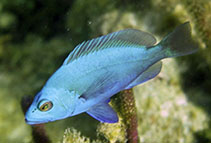
Épines dorsales (Total) : 10; Rayons mous dorsaux (Total) : 14 - 15; Épines anales: 3; Rayons mous anaux: 6 - 7; Vertèbres: 23. This species is distinguished from its congeners by the solid deep iridescent blue color and lack of black margins on fins. It is similarly colored as the blue hamlet, H. gemma, from Florida and the Yucatan; it is only distinguished by having dark black upper and lower margins on the caudal fin (Ref. 88139).
Body shape (shape guide): short and / or deep.
This species is often found among the mangrove roots that grow over shallow seagrass
beds. The colors of H. maya and the tunicate, Clavelina puerto-secensis, (growing on mangrove roots) are quite similar and perhaps this hamlet has evolved camouflage coloration against this tunicate. It has also been observed on several occasions that this species attacks small silversides (Jenkinsia lamprotaenia) which form diurnal aggregations among the mangrove roots (Ref. 88139). The conservation threats to this are related to climate-associated changes as well as coral-reef degradation and pollution due to the close proximity of their habitat to well-populated coastal areas (Ref. 137920).
Cycle de vie et comportement reproducteur
Maturité | Reproduction | Frai | Œufs | Fécondité | Larves
Lobel, P.S., 2011. A review of the Caribbean hamlets (Serranidae, Hypoplectrus) with description of two new species. Zootaxa 3096:1-17. (Ref. 88139)
Statut dans la liste rouge de l'IUCN (Ref. 130435: Version 2025-2 (Global))
Menacé (EN) (B1ab(i,ii,iii)+2ab(i,ii,iii)); Date assessed: 07 January 2020
Menace pour l'homme
Harmless
Utilisations par l'homme
Pêcheries: commercial
Outils
Articles particuliers
Télécharger en XML
Sources Internet
Estimations basées sur des modèles
Indice de diversité phylogénétique (Réf.
82804): PD
50 = 0.5000 [Uniqueness, from 0.5 = low to 2.0 = high].
Bayesian length-weight: a=0.01778 (0.00686 - 0.04609), b=3.03 (2.80 - 3.26), in cm total length, based on LWR estimates for this (Sub)family-body shape (Ref.
93245).
Niveau trophique (Réf.
69278): 3.7 ±0.4 se; based on size and trophs of closest relatives
Vulnérabilité de la pêche (Ref.
59153): Low vulnerability (10 of 100).
🛈