Klassifizierung / Names
Namen | Synonyme | Catalog of Fishes(Gattung, Arten) | ITIS | CoL | WoRMS | Cloffa
>
Siluriformes (Catfishes) >
Amphiliidae (Loach catfishes) > Doumeinae
Etymology: sagitta: The name Congoglanis sagitta, Latin for arrow,
refers to the slender, streamlined shape of this species
relative to that of its congeners; a noun in apposition (Ref. 88958).
More on authors: Ferraris, Vari & Skelton.
Umwelt: Milieu / Klimazone / Tiefenbereich / Verbreitungsgebiet
Ökologie
; süßwasser demersal. Tropical; 10°S - 13°S, 29°E - 32°E
Africa: upper Congo River basin, specifically in tributaries of Lake Mweru, Luongo River and Chambeshi River, Zambia (Ref. 88958).
Größe / Gewicht / Alter
Geschlechtsreife: Lm ? range ? - ? cm
Max length : 13.6 cm SL Männchen/unbestimmt; (Ref. 88958)
Kurzbeschreibung
Bestimmungsschlüssel | Morphologie | Morphometrie
Rückenflossenstacheln (insgesamt) : 0; Rückenflossenweichstrahlen (insgesamt) : 8; Afterflossenstacheln: 0; Afterflossenweichstrahlen: 10 - 11; Wirbelzahl: 39 - 41. Diagnosis: Congoglanis sagitta differs from C. inga in having a shorter maxillary barbel, not reaching to vertical through anterior margin of orbit vs. extending well past anterior margin of orbit; a shallower caudal-peduncle depth, 6% of standard length vs. 7–8%; and more slender caudal peduncle, its depth 3.1–4.0 times in its length vs. 2.1–2.9; a shorter pelvic fin, 19–21% of standard length vs. 22–25%; a more anteriorly placed anal fin, its origin well in advance of tip of adpressed pelvic fin vs. origin approximately at tip of adpressed pelvic fin; shorter anal-fin rays, posterior rays of adpressed anal fin extend to, rarely slightly beyond, vertical through posterior limit of adipose fin vs. posterior rays extend well past vertical through posterior limit of adipose fin; and more vertebrae, 39–41 vs. 35–37 (Ref. 88958). It differs from C. alula in having a shorter pectoral fin, 23–27% of standard length vs. 28–29%; a shorter pelvic fin, 19–21% of standard length vs. 24–28%; a longer caudal peduncle, 21–24% of standard length vs. 18–22%; and more slender caudal peduncle, its depth 3.1–4.0 times in its length vs. 2.6–3.3 times; a relatively wide interorbital width, 2 times eye diameter vs. 1.5 times; a more anteriorly placed anal fin, its origin well in advance of tip of adpressed pelvic fin vs. origin approximately at tip of adpressed pelvic fin; and more vertebrae, 39–41 vs. 36–39 (Ref. 88958).
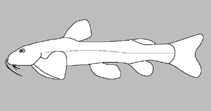
Body shape (shape guide): elongated.
Congoglanis sagitta is typically found in the fastest flowing portions of rivers and are always associated with large rocks; they appear to congregate underneath rocks near where water breaks over the rocks during the day, and will move out onto the tops of rocks at night (Ref. 88958).
Lebenszyklus und Paarungsverhalten
Geschlechtsreife | Fortpflanzung | Ablaichen | Eier | Fruchtbarkeit | Larven
Ferraris, C.J. Jr., R.P. Vari and P.H. Skelton, 2011. A new genus of African loach catfish (Siluriformes: Amphiliidae) from the Congo River basin, the sister-group to all other genera of the Doumeinae, with the description of two new species. Copeia 2011(4):477-489. (Ref. 88958)
IUCN Rote Liste Status (Ref. 130435: Version 2025-2 (Global))
Bedrohung für Menschen
Harmless
Nutzung durch Menschen
Tools
Zusatzinformationen
Download XML
Internet Quellen
Schätzungen auf der Grundlage von Modellen
Phylogenetischer Diversitätsindex (Ref.
82804): PD
50 = 0.5625 [Uniqueness, from 0.5 = low to 2.0 = high].
Bayesian length-weight: a=0.00389 (0.00180 - 0.00842), b=3.12 (2.94 - 3.30), in cm total length, based on all LWR estimates for this body shape (Ref.
93245).
Trophische Ebene (Ref.
69278): 3.1 ±0.4 se; based on size and trophs of closest relatives
Widerstandsfähigkeit (Ref.
120179): mittel, Verdopplung der Population dauert 1,4 - 4,4 Jahre. (Preliminary K or Fecundity.).
Anfälligkeit der Fischerei (Ref.
59153): Low vulnerability (10 of 100).
🛈