Clasificación / Nombres
Nombres comunes | Sinónimos | Catalog of Fishes(Género, Especie) | ITIS | CoL | WoRMS | Cloffa
>
Lophiiformes (Anglerfishes) >
Himantolophidae (Footballfishes)
Etymology: Himantolophus: Greek, himas or himantos = leather strap, thong or leash (referring to the thick leathery illicium) + Greek, lopho or lophio = crest or tuft (referring to the baited illicium projecting from the head) (Ref. 86949); stewarti: We are pleased to name this species in honor of Andrew Stewart of the Museum of New Zealand Te Papa Tongerewa (Te Papa), Wellington, for his years of service to the world ichthyological community and for his many published contributions to ichthyology (Ref. 88962).
Eponymy: Andrew Louis Stewart (d: 1958) is Collection Manager: Science (Fishes) at the Museum of New Zealand Te Papa Tongerewa. [...] (Ref. 128868), visit book page.
Entorno: milieu / zona climática / rango de profundidad / gama de distribución
Ecología
marino batidemersal; rango de profundidad 400 - 1413 m (Ref. 88962). Deep-water; 47°S - 48°S, 148°E - 149°E
Tasman Sea: South Tasman Rise. Himantolophus stewarti is probably everywhere sympatric with its sister species H. appelii, both restricted to the southern parts of the Atlantic, Indian, and Pacific oceans below 27°S and extending into the Southern Ocean. Most of the known material was taken off New Zealand and Tasmania, with scattered records from off southern Australia, the central and western Indian Ocean, off South Africa, the Falkland Islands, and off the southern tip of Chile. A large proportion of the known material (70%) was collected with bottom trawls at depth between 400 and 1413 m. Others were taken with midwater gear fished open between the surface and approximately 990 m, some at maximum depths well off the bottom (e.g., SAM 31615, 150 mm, maximum depth reached by gear 990 m, over a bottom depth of 2000 m) (Ref. 88962).
Tamaño / Peso / Edad
Madurez: Lm ? range ? - ? cm
Max length : 12.4 cm SL (female)
Descripción breve
Claves de identificación | Morfología | Morfometría
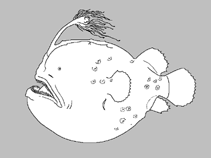
A species of the Himantolophus appelii group (as recognized by Bertelsen and Krefft, 1988), known only from females, distinguished from its sister-species, H. appelii, the only other member of this group, in having short distal and posterior escal appendages (Ref. 88962).
Body shape (shape guide): short and / or deep.
Ciclo vital y comportamiento de apareamiento
Madurez | Reproducción | Puesta | Huevos | Fecundidad | Larva
Pietsch, T.W. and C.P. Kenaley, 2011. A new species of deep-sea ceratioid anglerfish, genus Himantolophus (Lophiiformes: Himantolophidae), from southern waters of all three major oceans of the world. Copeia 2011(4):490-496. (Ref. 88962)
Situación en la Lista Roja de la UICN (Ref. 130435: Version 2025-2 (Global))
Amenaza para el ser humano
Harmless
Usos humanos
Herramientas
Informes especiales
Descargar XML
Fuentes de Internet
Estimaciones basadas en modelos
Índice de diversidad filogenética (Referencia
82804): PD
50 = 0.5000 [Uniqueness, from 0.5 = low to 2.0 = high].
Bayesian length-weight: a=0.01995 (0.00906 - 0.04395), b=3.01 (2.83 - 3.19), in cm total length, based on all LWR estimates for this body shape (Ref.
93245).
Nivel trófico (Referencia
69278): 4.1 ±0.7 se; based on size and trophs of closest relatives
Vulnerabilidad pesquera (Ref.
59153): Low vulnerability (10 of 100).
🛈