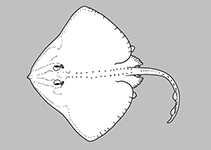
Elasmobranquios (tiburones y rayas) (sharks and rays) >
Rajiformes (Skates and rays) >
Arhynchobatidae (Softnose skates)
Etymology: vittacauda: A combination of the Latin vitta (ribbon) and cauda (tail) with reference to the appearance of the tail due to its unusually broad lateral skin folds that terminating near its tip. Vernacular name: Ribbontail Skate (Ref. 89011).
More on authors: Last & Séret.
Entorno: milieu / zona climática / rango de profundidad / gama de distribución
Ecología
marino batidemersal; rango de profundidad 629 - 973 m (Ref. 89011). Deep-water; 33°S - 35°S
Tasman Sea: known from small section of the West Norfolk Ridge (ca 33º40–34°18' S, 167º 50–168°24’ E) at 629–973 m depth (Ref. 89011).
Tamaño / Peso / Edad
Madurez: Lm ? range ? - ? cm
Max length : 71.9 cm WD macho / no sexado; (Ref. 89011)
Descripción breve
Claves de identificación | Morfología | Morfometría
A large species of Brochiraja distinguished by the following combination of characters: long tail, 1.2–1.4 times disc length, 2.3–2.8 times ventral head length, 4.7–5.8 times snout length; orbit moderately large, 2.8–3.1 in preorbital snout length; tail slender but with relatively broad conical base, evenly tapering to mid-length of tail, width at pelvic-fin insertions 2.0–2.5 times width at midlength; anterior lobe of pelvic fin broadly spatulate; central dorsal disc with fine denticles, otherwise naked apart from enlarged, thorn-like denticles around margin of snout and near alar patch in adult males; tail with mediodorsal row of about 36–51 hooked thorns and small spiny denticles concentrated on its dorsolateral surface; single preorbital thorn, 0–1 midorbital thorns, 1–3 postorbital thorns; snout length 2.6–3.7 times distance from snout tip to bifurcate rostral thorn; calcified rostral shaft short; ventral disc and tail naked; alar thorns in a broad patch, flanked by smaller malar thorns; additional separate patch of malar thorns on snout forward of mid-eye; lateral skin fold very broad posteriorly, originating well forward, beside pelvic-fin inner margins in adult male; dorsal surface dark violet, ventral surface brownish blue, darker than dorsal surface; no beard-like patch beneath mouth; rows of faint pale-edged pores on ventral surface; tail tip white; nuchal pore patch distinct; total pectoral radials 76–77; predorsal vertebrae 112–114; 40–44 tooth rows in upper jaw (Ref. 89011).
Body shape (shape guide): other.
Ciclo vital y comportamiento de apareamiento
Madurez | Reproducción | Puesta | Huevos | Fecundidad | Larva
Last, P.R. and B. Séret, 2012. Two new softnose skates of the genus Brochiraja (Rajoidei: Arhynchobatidae) from the deepwater slopes and banks of the Norfolk Ridge (South-West Pacific). Zootaxa 3155:47-64. (Ref. 89011)
Situación en la Lista Roja de la UICN (Ref. 130435: Version 2025-2 (Global))
Amenaza para el ser humano
Harmless
Usos humanos
Herramientas
Informes especiales
Descargar XML
Fuentes de Internet
Estimaciones basadas en modelos
Índice de diversidad filogenética (Referencia
82804): PD
50 = 0.5039 [Uniqueness, from 0.5 = low to 2.0 = high].
Bayesian length-weight: a=0.00550 (0.00279 - 0.01081), b=3.11 (2.94 - 3.28), in cm total length, based on LWR estimates for this (Sub)family-body shape (Ref.
93245).
Nivel trófico (Referencia
69278): 3.8 ±0.7 se; based on size and trophs of closest relatives
Vulnerabilidad pesquera (Ref.
59153): Moderate vulnerability (42 of 100).
🛈