>
Perciformes/Serranoidei (Groupers) >
Anthiadidae (Fairy basslets or Streamer basses)
Etymology: Giganthias: Latin, gigas, giganteum = giant + Greek, anthias = a fish, Saprus aurata (Ref. 45335); serratospinosus: Named based on combination of the Latin (serrate) and spina (spine) in allusion to the serrate tips to the anterior dorsal and pelvic spines which is a key diagnostic feature of this genus of anthiine fish (Ref. 89066).
Environnement : milieu / zone climatique / profondeur / gamme de distribution
Écologie
marin pelagic-neritic. Tropical
Indian Ocean: Indonesia. Known only from East Lombok in the Nusa Tenggara region of Indonesia. The type specimen was collected from the fish market at Tanjung Luar (East Lombok) and caught by handline fishers operating in local waters. Thus, it was not translocated from other fishing areas like much of the landed catch (Ref. 89066).
Taille / Poids / Âge
Maturité: Lm ? range ? - ? cm
Max length : 23.7 cm SL mâle / non sexé; (Ref. 89066)
Description synthétique
Clés d'identification | Morphologie | Morphométrie
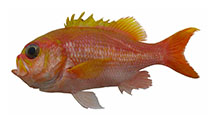
Dorsal-fin rays IX, 12; anal-fin rays III, 8; pectoral-fin rays 13–14; lateral-line scales 44; gill rakers 30 (10+20); body depth 2.2 in SL; eye large, orbit diameter 3.2 in head length; no prominent spine at angle of preopercle; vomerine tooth patch very small, triangular with rounded edges; no teeth on endopterygoids; scales dorsally on head reaching to about level of mid-eye, head naked anteriorly; maxilla fully scaled; tips of first to fourth dorsal spines and pelvic spine expanded with coarse serrations; fourth dorsal spine longest, 3.5 in head length; longest dorsal-fin soft ray 2.3 in SL; third anal-fin spine longest, 2.3 in head length; caudal fin lunate, lobes not tapering, fin length 3.5 in SL; pectoral fins 1.4 in head length; pelvic fins reaching to level of anus, 4.3 in SL (Ref. 89066).
Cycle de vie et comportement reproducteur
Maturité | Reproduction | Frai | Œufs | Fécondité | Larves
White, W.T. and Dharmadi, 2012. Giganthias serratospinosus, a new serranid (Perciformes: Serranidae: Anthiinae) from the island of Lombok in Indonesia. Zootaxa 3161:60-66. (Ref. 89066)
Statut dans la liste rouge de l'IUCN (Ref. 130435: Version 2025-2 (Global))
Menace pour l'homme
Harmless
Utilisations par l'homme
Outils
Articles particuliers
Télécharger en XML
Sources Internet
Estimations basées sur des modèles
Indice de diversité phylogénétique (Réf.
82804): PD
50 = 0.7500 [Uniqueness, from 0.5 = low to 2.0 = high].
Bayesian length-weight: a=0.01413 (0.00621 - 0.03212), b=3.00 (2.81 - 3.19), in cm total length, based on LWR estimates for this (Sub)family-body shape (Ref.
93245).
Niveau trophique (Réf.
69278): 3.6 ±0.5 se; based on size and trophs of closest relatives
Résilience (Réf.
120179): Milieu, temps minimum de doublement de population : 1,4 à 4,4 années (Preliminary K or Fecundity.).
Vulnérabilité de la pêche (Ref.
59153): Low vulnerability (19 of 100).
🛈