>
Ovalentaria/misc (Various families in series Ovalentaria) >
Pseudochromidae (Dottybacks) > Pseudochrominae
Etymology: Pseudochromis: Greek, pseudes = false + Greek, chromis = a fish, perhaps a perch (Ref. 45335).
Eponymy: Maximilian Johannes ‘Max’ Ammer (d: 1961) of Sorong, West Papua, is a Dutch diver and conservationist. [...] (Ref. 128868), visit book page.
More on authors: Gill, Allen & Erdmann.
Milieu: milieu / Klimaatzone / Diepte / verspreidingsgebied
Ecologie
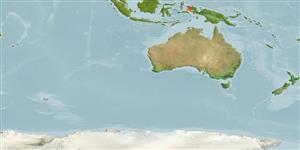
marien rifbewoner; diepte 10 - 45 m (Ref. 90102). Tropical; 0°S - 3°S, 130°E - 133°E
Pacific Ocean: Indonesia (endemic to the Raja Ampat Islands).
Grootte / Gewicht / Leeftijd
Maturiteit: Lm ? range ? - ? cm
Max length : 6.0 cm SL mannelijk / geslacht onbekend; (Ref. 89094)
Korte beschrijving
Determinatiesleutels | Morfologie | Morfometrie
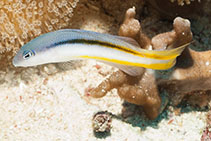
Dorsale stekels (totaal) : 3; Dorsale zachte stralen (totaal) : 24 - 25; Anale stekels: 3; Anale zachte stralen: 14; Wervels: 26. This species differs from other pseudochromids in having the following set of characters: D III,24-25, usually III,24; A III,14; pelvic-fin rays I,5; anterior tip of palatine tooth patch directed medially behind posterolateral arm of vomerine tooth patch; upper part of body with dark (dark grey to black in life) longitudinal stripe, when present it is extending horizontally to or towards caudal-fin base; scales in lateral series 39-43; circumpeduncular scales 20-21, usually 20 (Ref. 89094).
Body shape (shape guide): elongated; Cross section: compressed.
This species is generally found around isolated, small coral and rock outcrops in both silty and clear water reef environments, usually in about 10-45 m depth (sometimes seen as deep as 60 m). Occurs solitarily or in small loose groups, is relatively curious and easy to photograph, though it invariably retreats into crevices or under coral heads when approached too closely (Ref. 89094).
Levenscyclus en paargedrag
Maturiteit | Voortplanting | Paaien | Eieren | Fecunditeit | Larven
Gill, A.C., G.R. Allen and M. Erdmann, 2012. Two new species of striped Pseudochromis from the Philippine Islands and Indonesia, with a redescription of P. colei (Perciformes: Pseudochromidae). Zootaxa 3165:25-38. (Ref. 89094)
Status op de Rode Lijst van het IUCN (Ref. 130435: Version 2025-2 (Global))
Gevaar voor de mens
Harmless
Gebruik door de mens
Tools
Speciale rapporten
Download XML
Internetbronnen
Schattingen op basis van modellen
Gewenste temperatuur (Ref.
123201): 27.4 - 29.1, mean 28.7 °C (based on 20 cells).
Fylogenetische diversiteitsindex (Ref.
82804): PD
50 = 0.5000 [Uniqueness, from 0.5 = low to 2.0 = high].
Bayesian length-weight: a=0.00501 (0.00191 - 0.01317), b=3.10 (2.88 - 3.32), in cm total length, based on LWR estimates for this (Sub)family-body shape (Ref.
93245).
Trofisch niveau (Ref.
69278): 3.4 ±0.5 se; based on size and trophs of closest relatives
Kwetsbaarheid van de visserij (Ref.
59153): Low vulnerability (10 of 100).
🛈
Voedingsstoffen (Ref.
124155): Calcium = 191 [93, 322] mg/100g; Iron = 0.899 [0.521, 1.544] mg/100g; Protein = 18.2 [17.1, 19.3] %; Omega3 = 0.116 [0.063, 0.212] g/100g; Selenium = 26.1 [11.5, 58.2] μg/100g; VitaminA = 159 [49, 510] μg/100g; Zinc = 2.32 [1.50, 3.36] mg/100g (wet weight);