Elasmobranchii (hajar och rockor) (sharks and rays) >
Rajiformes (Skates and rays) >
Arhynchobatidae (Softnose skates)
Etymology: Bathyraja: Greek, bathys = deep + Latin, raja, -ae = a ray (Raja sp) (Ref. 45335); leucomelanos: The species name leucomelanos, derived from the Greek leuco (white) and melanos (black), refers to the coloration with white and black dorsal and ventral surfaces, respectively.
Miljö: miljö / Klimatzon / djupintervall / distributionsområde
Ekologi
marina djupbottenlevande, usually 953 - 1022 m (Ref. 89184). Tropical; 20°S - 22°S, 157°E - 160°E (Ref. 114953)
Southwest Pacific: Coral Sea (off New Caledonia).
Storlek / Vikt / Ålder
Könsmognad: Lm ? range ? - ? cm
Max length : 88.8 cm TL hane/ej könsbestämd; (Ref. 89184)
Kort beskrivning
Bestämningsnycklar | Morfologi | Morfometri
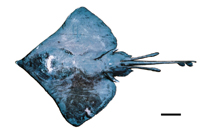
A medium-sized species of Bathyraja with the following combination of characters: snout long, pointed and very broad, supported by a slender flexible medial cartilage; margin of disc (anterior two-thirds) straight. Orbit about 6.0 times in preorbital length and 0.73 times interorbital width. Mouth moderately broad, 6.8% TL; outer margins of nasal curtain with distinct, broadly triangular lobelet immediately posterior to each nostril; posterior margin of nasal curtain with prominent fringes. Tail of moderate length (about 0.9 times precloacal length), slightly depressed and slender; lateral skin fold moderately developed. Dorsal surface of disc and tail entirely covered with small and fine dermal denticles; ventral surface naked; disc entirely free of enlarged thorns; tail with single median row of 18 large thorns laterally compressed. Dorsal fins small, oblique, about equal in height; epichordal caudal-fin lobe developed. Dorsal surface mostly uniformly white except for black color along disc and tail margins, anterior lobes of pelvic fins, claspers, and dorsal fins. Ventral surface entirely black. Clasper glans with pseudosiphon and component projection; ventral terminal cartilage spoonlike; accessory terminal 2 cartilage with an expanded disc-shaped tip. Distal section of crowns of alar thorns undulating. Tooth rows: 30 in upper jaw, 28 in lower jaw; trunk centra 35; predorsal caudal centra 70; diplospondylous centra 109; pectoral-fin radials 88 (Ref. 89184).
Body shape (shape guide): other; Cross section: flattened.
Probably a benthic species, found more widespread on deep insular slopes of Coral Sea (Ref. 114953).
Livscykel och parningsbeteende
Könsmognad | Reproduktion | Lek | Ägg | Fekunditet | Larver
Iglésias, S.P. and L. Lévy-Hartmann, 2012. Bathyraja leucomelanos, a new species of softnose skate (Chondrichthyes: Arhynchobatidae) from New Caledonia. Ichthyol. Res. 59(1):38-48. (Ref. 89184)
Status på IUCN:s rödlista (Ref. 130435: Version 2025-2 (Global))
Hot mot människor
Harmless
Mänskliga användningsområden
Verktyg
Särskilda rapporter
Ladda ner XML
Internet-källor
Uppskattningar baserade på modeller
Index för fylogenetisk mångfald (Ref.
82804): PD
50 = 0.5000 [Uniqueness, from 0.5 = low to 2.0 = high].
Bayesian length-weight: a=0.00562 (0.00296 - 0.01067), b=3.13 (2.97 - 3.29), in cm total length, based on LWR estimates for this Genus-body shape (Ref.
93245).
Trofisk nivå (Ref.
69278): 4.0 ±0.7 se; based on size and trophs of closest relatives
Sårbarhet i fisket (Ref.
59153): High vulnerability (56 of 100).
🛈