Klassifizierung / Names
Namen | Synonyme | Catalog of Fishes(Gattung, Arten) | ITIS | CoL | WoRMS | Cloffa
>
Perciformes/Scorpaenoidei (Scorpionfishes) >
Triglidae (Searobins) > Pterygotriglinae
Etymology: Pterygotrigla: Greek, pterigion, diminutive of pteryx = wing, fin + Greek, trigla, es = red mullet (Ref. 45335); saumarez: The epithet saumarez is used as a noun in apposition and refers to the general collection locality of most of the type specimens, the offshore plateau associated with the Saumarez Reef in the Coral Sea (Ref. 89393).
Eponymy: This is a toponym referring to the Saumarez Reef in the Coral Sea, the general collecting area for most of the type series. (Ref. 128868), visit book page.
More on authors: Last & Richards.
Umwelt: Milieu / Klimazone / Tiefenbereich / Verbreitungsgebiet
Ökologie
seewasser demersal. Subtropical
Verbreitung
Territorien | FAO Gebiete | Ökosysteme | Vorkommen | Punkt Karte | Einführungen | Faunafri
Western Pacific: Australia.
Größe / Gewicht / Alter
Geschlechtsreife: Lm ? range ? - ? cm
Max length : 18.6 cm SL Männchen/unbestimmt; (Ref. 89393)
Kurzbeschreibung
Bestimmungsschlüssel | Morphologie | Morphometrie
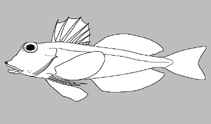
This species is distinguished by having a black pigment on the nasal openings (nares); long pectoral fin (41-51% SL) with 12+3 rays; scales lacking on nape, prepectoral area, breast, and interpelvic area; no indication of hyperostosis (Ref. 91768).
Body shape (shape guide): fusiform / normal; Cross section: angular.
Lebenszyklus und Paarungsverhalten
Geschlechtsreife | Fortpflanzung | Ablaichen | Eier | Fruchtbarkeit | Larven
Last, P.R. and W.J. Richards, 2012. Two new gurnards of the genus Pterygotrigla (Scorpaeniformes: Triglidae) from Australian seas. Zootaxa 3195:39-50. (Ref. 89393)
IUCN Rote Liste Status (Ref. 130435: Version 2025-2 (Global))
Bedrohung für Menschen
Harmless
Nutzung durch Menschen
Fischereien: kommerzielles potential
Tools
Zusatzinformationen
Download XML
Internet Quellen
Schätzungen auf der Grundlage von Modellen
Phylogenetischer Diversitätsindex (Ref.
82804): PD
50 = 0.5000 [Uniqueness, from 0.5 = low to 2.0 = high].
Bayesian length-weight: a=0.00955 (0.00411 - 0.02221), b=3.05 (2.84 - 3.26), in cm total length, based on LWR estimates for this (Sub)family-body shape (Ref.
93245).
Trophische Ebene (Ref.
69278): 3.6 ±0.5 se; based on size and trophs of closest relatives
Widerstandsfähigkeit (Ref.
120179): mittel, Verdopplung der Population dauert 1,4 - 4,4 Jahre. (Preliminary K or Fecundity.).
Anfälligkeit der Fischerei (Ref.
59153): Low vulnerability (13 of 100).
🛈