>
Blenniiformes (Blennies) >
Blenniidae (Combtooth blennies) > Salariinae
Etymology: Alloblennius: Greek, allos = other + Greek, blennios = mucus (Ref. 45335); frondiculus: Name from the Latin frondiculus (a small leaf) in reference to the shape of the orbital cirrus; noun in appositional.
Environnement : milieu / zone climatique / profondeur / gamme de distribution
Écologie
marin démersal; profondeur 0 - 3 m (Ref. 89414). Tropical
Indian Ocean: Andaman Islands. South Cinque I., SW coast (Ref. 89414).
Taille / Poids / Âge
Maturité: Lm ? range ? - ? cm
Max length : 2.4 cm SL mâle / non sexé; (Ref. 89414)
Description synthétique
Clés d'identification | Morphologie | Morphométrie
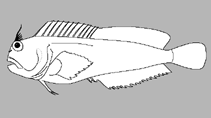
Épines dorsales (Total) : 12; Rayons mous dorsaux (Total) : 18; Épines anales: 2; Rayons mous anaux: 20; Vertèbres: 37. This species is distinguished by the following characters: pinnately branched, supraorbital cirrus about equal eye diameter in height; small nape cirrus; lower jaws with relatively large, heavily pigmented labial flap on either side of chin; innermost (third), segmented pelvic-fin ray obvious externally (Ref. 89414).
Body shape (shape guide): fusiform / normal.
Known from its type locality which is situated next to shore along a wave-exposed coast in 0-3 m depth; the bottom with large algal-covered boulders in an area of very strong surge (Ref. 89414). Oviparous. Eggs are demersal and adhesive (Ref. 205), and are attached to the substrate via a filamentous, adhesive pad or pedestal (Ref. 94114). Larvae are planktonic, often found in shallow, coastal waters (Ref. 94114).
Cycle de vie et comportement reproducteur
Maturité | Reproduction | Frai | Œufs | Fécondité | Larves
Oviparous, distinct pairing (Ref. 205).
Smith-Vaniz, W.F. and G.R. Allen, 2012. Alloblennius frondiculus, a new species of blenny from the Andaman Islands (Teleostei: Blenniidae: Salariini). Zootaxa 3199:60-65. (Ref. 89414)
Statut dans la liste rouge de l'IUCN (Ref. 130435: Version 2025-2 (Global))
Menace pour l'homme
Harmless
Utilisations par l'homme
Outils
Articles particuliers
Télécharger en XML
Sources Internet
Estimations basées sur des modèles
Indice de diversité phylogénétique (Réf.
82804): PD
50 = 0.5312 [Uniqueness, from 0.5 = low to 2.0 = high].
Bayesian length-weight: a=0.01047 (0.00463 - 0.02370), b=2.98 (2.79 - 3.17), in cm total length, based on LWR estimates for this (Sub)family-body shape (Ref.
93245).
Résilience (Réf.
120179): Haut, temps minimum de doublement de population inférieur à 15 mois (Preliminary K or Fecundity.).
Vulnérabilité de la pêche (Ref.
59153): Low vulnerability (10 of 100).
🛈