>
Cypriniformes (Carps) >
Cyprinidae (Minnows or carps) > Labeoninae
Etymology: Garra: Name based on a vernacular Indian name (Hamilton, 1822:343, Ref. 1813); a fish living in mud (Ref. 128817); kalpangi: Named for its type locality, River Kalpangi in Yazali, Lower Subansiri District, Arunachal Pradesh; noun in apposition.
Eponymy: A toponym, referring to the River Kalpangi in Arunachal Pradesh, India, where the species was first found. (Ref. 128868), visit book page.
Lingkungan: lingkungan / zona iklim / kisaran kedalaman / jangkauan distribusi
Ekologi
; air tawar bentopelagis. Tropical
Asia: India.
Ukuran / Berat / umur
Kematangan: Lm ? range ? - ? cm
Max length : 7.2 cm SL jantan/; (Ref. 89473)
deskripsi pendek
Kunci identifiaksi (pengenalan) | Morfologi | Morfometrik
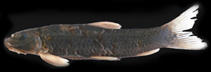
duri punggung lunak (Keseluruhan (total)) : 10 - 11; Sirip dubur lunak: 7 - 8. This species is distinguished from its congeners of the Himalayan foothills by the following characters: two pairs of barbels; proboscis poorly developed, represented by a squarish area in front of the nostrils; circumpeduncular scales 16; similar to G. gravelyi, G. rotundinasus and G. elongata in having a weakly developed proboscis on the snout. This species is differentiated from G. gravelyi in having branched dorsal-fin rays 8 (vs. 7), branched pectoral-fin rays 10-12 (vs. 13), predorsal scales 10-11 (vs. 8–9), absence (vs. presence) of indistinct black spots at the bases of the branched dorsal-fin rays, absence (vs. presence) of lateral stripes on side of body; from G. rotundinasus in having branched pectoral-fin rays 10-12 (vs.13-15), lateral line scales 32-33 (vs. 36-37), scales between vent and anal-fin origin 3 (vs. 5), transverse scale rows above lateral line 3½ (vs. 2½), transverse scale rows below lateral line 3½-4 (vs. 2½-3), circumpeduncular scales 16 (vs. 12), absence (vs. subtle presence) of lateral stripe along lateral line; from G. elongata in having lateral line scales 32-33 (vs. 40-41), predorsal scales 10-11 (vs. 14-15), branched dorsal-fin rays 8 (vs.7), absence (vs. presence) of transverse groove at tip of snout, absence (vs. presence) of pleated papilliferous fold at corner of mouth, absence (vs. presence) of a wide submarginal band on dorsal fin, absence (vs. presence) of a longitudinal median black band on caudal fin (Ref. 89473).
Body shape (shape guide): elongated; Cross section: compressed.
Siklus hidup dan perilaku kawin
Kematangan | Reproduksi, perkembang biakan | Pemijahan | telur-telur | Fekunditas | Larva
Nebeshwar, K., K. Bagra and D.N. Das, 2012. Garra kalpangi, a new cyprinid fish species (Pisces: Teleostei) from upper Brahmaputra basin in Arunachal Pradesh, India. Journal of Threatened Taxa 4(2):2353-2362. (Ref. 89473)
Status IUCN Red List (Ref. 130435: Version 2025-2 (Global))
ancaman kepada manusia
Harmless
penggunaan manusia
Perikanan: tidak ada kepentingan
Alat, peralatan
laporan khas
muat turun XML
Sumber internet
Estimasi berdasarkan model
Indeks keanekaragaman filogenetik (Acuan
82804): PD
50 = 0.5000 [Uniqueness, from 0.5 = low to 2.0 = high].
Bayesian length-weight: a=0.00794 (0.00359 - 0.01758), b=3.04 (2.87 - 3.21), in cm total length, based on LWR estimates for this Genus-body shape (Ref.
93245).
Kerentanan Penangkapan Ikan (Ref.
59153): Low vulnerability (10 of 100).
🛈