Klassificering / Namn
Populärnamn | synonymer | Catalog of Fishes(Släkte, Arter) | ITIS | CoL | WoRMS | Cloffa
>
Siluriformes (Catfishes) >
Loricariidae (Armored catfishes) > Hypoptopomatinae
Etymology: Neoplecostomus: Greek, neos = new + Greek, plekos,-eos = twisted (Ref. 45335); langeanii: The specific name, langeanii, is in honor of researcher Francisco Langeani Neto from Universidade Estadual Paulista (UNESP), Instituto de Biociências, Letras e Ciência Exatas, in recognition of his dedication and contributions to the study of Neotropical fishes (Ref. 89726).
Eponymy: Dr Francisco Langeani Neto is a Brazilian ichthyologist who specialises in Neotropical fish at Universidade Estadual Paulista, Instituto de Biociências, Letras e Ciências Exatas, where he is an adjunct professor. [...] (Ref. 128868), visit book page.
Miljö: miljö / Klimatzon / djupintervall / distributionsområde
Ekologi
; sötvatten bottenlevande. Tropical
South America: Brazil. Found in the drainages of Rio Muzambinho in the municipality of Muzambinho, Minas Gerais state (Ref. 89726).
Storlek / Vikt / Ålder
Könsmognad: Lm ? range ? - ? cm
Max length : 8.6 cm SL hane/ej könsbestämd; (Ref. 89726)
Kort beskrivning
Bestämningsnycklar | Morfologi | Morfometri
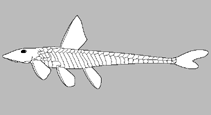
Neoplecostomus langeanii differs from N. bandeirante by the absence of keels along each lateral series of plates (vs. presence of moderate keels). Neoplecostomus langeanii differs from N. botucatu and N. paranensis, by having a well-developed adipose fin (vs. adipose fin reduced or absent). Neoplecostomus langeanii differs from N. franciscoensis and N. ribeirensis, by having a dorsal-fin spinelet larger than dorsal-fin spine (vs. dorsal-fin spinelet absent to vestigial and more slender than dorsal-fin spine). Neoplecostomus langeanii differs from N. granosus, N. microps, and N. variipictus by the presence of five conspicuous dark bands on dorsum and lacking evident dark spots (vs. conspicuous dark spots all over body and fins and dorsal bands not evident) characteristics that are more evident in mature adults. Neoplecostomus langeanii is distinguished from N. selenae by lacking enlarged odontodes and a distinct, swollen integument along lateral margins of snout and along ridges anterior to eyes (vs. having enlarged odontodes and distinct swollen integument along lateral margins of snout and along ridges anterior to eyes). Neoplecostomus langeanii is distinguished from N. corumba by having smaller orbital diameter 8.3-11.4% in head length, 12.9–18.5% in snout length, and 27.0–35.7% in interorbital length (vs. 12.2–13.05%, 18.4–20.1%, and 36.7–41.5%, respectively); from N. yapo, by having a smaller interdorsal length, ranging from 14.8–19.5% in SL (vs. 20.7–23.0%), greater caudal peduncle depth 19.8–29.0% in caudal peduncle length (vs. 17.6–19.6%), smaller orbital diameter 8.3–11.4% in head length (vs. 11.9–21.4%); from N. espiritosantensis, by having greater cleithral width 25.6–30.0% in SL (vs. 19.0–21.0%) (Ref. 89726).
Body shape (shape guide): elongated.
Livscykel och parningsbeteende
Könsmognad | Reproduktion | Lek | Ägg | Fekunditet | Larver
Roxo, F.F., C. Oliveira and C.H. Zawadzki, 2012. Three new species of Neoplecostomus (Teleostei: Siluriformes: Loricariidae) from the Upper Rio Paraná basin of southeastern Brazil. Zootaxa 3233:1-21. (Ref. 89726)
Status på IUCN:s rödlista (Ref. 130435: Version 2025-2 (Global))
Hot mot människor
Harmless
Mänskliga användningsområden
Verktyg
Särskilda rapporter
Ladda ner XML
Internet-källor
Uppskattningar baserade på modeller
Index för fylogenetisk mångfald (Ref.
82804): PD
50 = 0.5000 [Uniqueness, from 0.5 = low to 2.0 = high].
Bayesian length-weight: a=0.00977 (0.00434 - 0.02202), b=3.06 (2.87 - 3.25), in cm total length, based on LWR estimates for this (Sub)family-body shape (Ref.
93245).
Sårbarhet i fisket (Ref.
59153): Low vulnerability (10 of 100).
🛈