>
Carangaria/misc (Various families in series Carangaria) >
Sphyraenidae (Barracudas)
Etymology: Sphyraena: Greek, sphyraina, -es = the name of a fish (Ref. 45335).
Eponymy: Edmund Heller (1875–1939) was an American zoologist. [...] (Ref. 128868), visit book page.
Taxonomic Remarks
References and information for Hawaii are retained (including common names). All other references from different study areas are questionable or refer to another species of Sphyraena.
Environnement : milieu / zone climatique / profondeur / gamme de distribution
Écologie
marin récifal; profondeur 10 - 104 m (Ref. 58302). Subtropical; 23°N - 18°N, 161°W - 154°W (Ref. 123366)
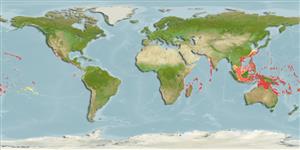
Eastern Pacific: Hawaii endemic.
Taille / Poids / Âge
Maturité: Lm ? range ? - ? cm
Max length : 54.6 cm SL mâle / non sexé; (Ref. 123366); poids max. publié: 1.8 kg (Ref. 4887)
Épines dorsales (Total) : 6; Rayons mous dorsaux (Total) : 9; Épines anales: 2; Rayons mous anaux: 8 - 9. This species is distinguished by the following set of characters: first gill arch with one gill raker; pelvic-fin insertion is located slightly before vertical through first dorsal-fin origin; pored lateral-line scales 121-127, total lateral-line scales 132-134; scales above lateral line 12-13 and below 14-15; snout comparatively long, its length 15.0-16.4% SL; upper jaw long, the posterior tip reaching to or beyond anterior nostril, but not reaching to below posterior nostril, its length 11.9-12.9% SL; eye large, orbit diameter 4.8-5.9 % SL and depth 4.8-5.6% SL; anal-fin base somewhat short, its length 6.8-7.5% SL; last dorsal- and anal-fin ray lengths 4.2-4.3% SL and 3.6-4.7% SL, respectively; anus is comparatively close to anal-fin origin, its anterior and posterior margins to anal-fin origin 6.5-8.2 % HL and 4.1-4.9% HL, respectively; the head sensory canal pores on suborbital area are simple or sometimes slightly branched, their lowermost parts very close to lacrimal bone margin, large smooth area lacking canal pores absent on mid-margin of lacrimal bone. Colouration: lateral surface of body no stripes or bands; caudal fin gray (Ref. 123366).
Cross section: compressed.
Mainly nocturnal (Ref. 4887).
Cycle de vie et comportement reproducteur
Maturité | Reproduction | Frai | Œufs | Fécondité | Larves
Morishita, S. and H. Motomura, 2020. Sphyraena stellata, a new barracuda from the Indo-Pacific, with redescriptions of S. helleri Jenkins, 1901 and S. novaehollandiae Günther, 1860 (Perciformes: Sphyraenidae). Zootaxa 4772(3):545-566. (Ref. 123366)
Statut dans la liste rouge de l'IUCN (Ref. 130435: Version 2025-2 (Global))
Menace pour l'homme
Harmless
Utilisations par l'homme
Pêcheries: commercial
Outils
Articles particuliers
Télécharger en XML
Sources Internet
Estimations basées sur des modèles
Température préférée (Réf.
123201): 24.7 - 28.8, mean 27.5 °C (based on 566 cells).
Indice de diversité phylogénétique (Réf.
82804): PD
50 = 0.5000 [Uniqueness, from 0.5 = low to 2.0 = high].
Bayesian length-weight: a=0.00708 (0.00326 - 0.01539), b=2.92 (2.74 - 3.10), in cm total length, based on LWR estimates for this Genus-body shape (Ref.
93245).
Niveau trophique (Réf.
69278): 4.5 ±0.80 se; based on food items.
Résilience (Réf.
120179): Milieu, temps minimum de doublement de population : 1,4 à 4,4 années (Preliminary K or Fecundity.).
Vulnérabilité de la pêche (Ref.
59153): Moderate to high vulnerability (47 of 100).
🛈
Nutriments (Ref.
124155): Calcium = 10.3 [4.7, 30.8] mg/100g; Iron = 0.285 [0.122, 0.637] mg/100g; Protein = 20.9 [18.9, 22.6] %; Omega3 = 0.141 [0.060, 0.310] g/100g; Selenium = 17.5 [6.8, 45.7] μg/100g; VitaminA = 29.3 [5.9, 164.1] μg/100g; Zinc = 0.303 [0.180, 0.533] mg/100g (wet weight);