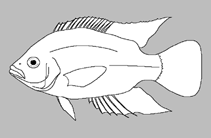
>
Cichliformes (Cichlids, convict blennies) >
Cichlidae (Cichlids) > Pseudocrenilabrinae
Etymology: Melanochromis: Greek, melas, melanos = black + Greek, chromis = a fish, perhaps a perch (Ref. 45335); mpoto: The specific epithet, a noun in apposition, is derived from ChiTumbuka, the language spoken along the northwestern lake shore, and means “northern,” referring to the distribution pattern of this species (Ref. 89864).
Taxonomic Remarks
Also reported as Melanochromis 'blue' by Ribbink et al. (1983) (Ref. 89864).
Môi trường: môi trường / vùng khí hậu / Mức độ sâu / phạm vi phân phối
Sinh thái học
; nước ngọt sống nổi và đáy; mức độ sâu 20 - 40 m (Ref. 89864). Tropical
Africa: endemic to Lake Malawi, in the northern part of the lake in Malawi and Tanzania (Ref. 89864).
Bộ gần gũi / Khối lượng (Trọng lượng) / Tuổi
Chín muồi sinh dục: Lm ? range ? - ? cm
Max length : 9.1 cm SL con đực/không giới tính; (Ref. 89864)
Mô tả ngắn gọn
Khóa để định loại | Hình thái học | Sinh trắc học
Các tia vây lưng cứng (tổng cộng) : 17 - 18; Các vây lưng mềm (tổng cộng) : 9 - 10; Tia cứng vây hậu môn: 3; Tia mềm vây hậu môn: 7 - 8. Diagnosis: Females and non-breeding males of Melanochromis mpoto are distinguished from all congeners, except M. melanopterus, M. vermivorus, and M. baliodigma, by a dark brown body and a melanin pattern, when discernible, consisting of two dark horizontal stripes combined with dark vertical bars; the only other Melanochromis species with such a pattern is M. baliodigma, but M. mpoto differs from the latter species by having vertical bars that are narrower than either horizontal stripe; in M. baliodigma the vertical bars are much wider than the horizontal stripes; mouthbrooding females of M. robustus can exhibit vertical bars as well, but this species has a greater interorbital width compared to that of M. mpoto, 26.1-29.6% of head length vs. 14.8-21.8% in M. mpoto (Ref. 89864). Melanochromis mpoto differs from M. melanopterus and M. vermivorus by a shallower cheek depth, 15.4-21.7% of head length vs. 22.9-31.7% of head length in M. melanopterus and 28.2-36.2% of head length in M. vermivorus (Ref. 89864). Male M. mpoto in breeding colouration are light blue/blue without any bars or stripes visible on the flank; and Melanochromis mpoto males are thus distinguished from those of most other Melanochromis species except M. lepidiadaptes, M. kaskazini, and M. wochepa; Melanochromis mpoto differs from M. wochepa males and females by its longer lower jaw, 38.1-42.4% of head length vs. 26.7-32.5% in M. wochepa); it differs from M. lepidiadaptes males by the black submarginal band in its anal fin, which is entirely light blue in fully coloured males of M. lepidiadaptes; in partially coloured males of the latter species the black horizontal stripes are visible, but no vertical bars are present, as is the case in M. mpoto (Ref. 89864). Males of M. mpoto differ from those of M. kaskazini by possessing more teeth in the lower jaw, 18-23 vs. 10-16 in M. kaskazini; by having a shallower preorbital depth, 15.4-20.4% of head length vs. 19.3-26.9% in M. kaskazini; and by possessing a shallower cheek, 15.4-21.7% of head length vs. 19.8-28.0% in M. kaskazini; fully coloured males of M. mpoto and M. kaskazini are indistinguishable on the basis of colouration alone, but the basic melanin patterns of the two species, as seen in juveniles and adult females, differ dramatically (Ref. 89864).
Body shape (shape guide): fusiform / normal.
Melanochromis mpoto is a non-specialized, non-territorial cichlid, which lives in rocky and intermediate habitats; often seen at depths of 20-40 m (Ref. 89864). It lives a predatory life but has also been seen feeding on plankton; larger specimens appear to be mainly opportunistic piscivores (Ref. 89864). Adults are usually solitary but quick to form small 'packs' of up to a dozen individuals when hunting opportunities arise; such packs can contain more than a single male in breeding colouration; these small packs move quickly through the habitat, apparently causing commotion among small prey fishes and invertebrates, and scavenging on anything that seems worth consuming (Ref. 89864). Mouthbrooding females are solitary and sometimes found in water shallower than 10 m (Ref. 89864).
Vòng đời và hành vi giao phối
Chín muồi sinh dục | Sự tái sinh sản | Đẻ trứng | Các trứng | Sự sinh sản | Ấu trùng
Konings, A.F. and J.R. Stauffer Jr., 2012. Review of the Lake Malawi genus Melanochromis (Teleostei: Cichlidae) with a description of a new species. Zootaxa 3258:1-27. (Ref. 89864)
Tình trạng Sách đỏ IUCN (Ref. 130435: Version 2025-2 (Global))
Mối đe dọa đối với con người
Harmless
Sử dụng của con người
Các công cụ
Báo cáo đặc biệt
Tải xuống XML
Các nguồn internet
Ước tính dựa trên mô hình
Chỉ số đa dạng phát sinh loài (Tài liệu tham khảo
82804): PD
50 = 0.5000 [Uniqueness, from 0.5 = low to 2.0 = high].
Bayesian length-weight: a=0.01445 (0.00671 - 0.03113), b=2.99 (2.82 - 3.16), in cm total length, based on LWR estimates for this (Sub)family-body shape (Ref.
93245).
Mức dinh dưỡng (Tài liệu tham khảo
69278): 3.3 ±0.5 se; based on size and trophs of closest relatives
Sự dễ bị tổn thương của nghề đánh cá (Ref.
59153): Low vulnerability (10 of 100).
🛈