Ταξινόμηση / Ονόματα
Κοινά ονόματα | Συνώνυμα | Catalog of Fishes(Γένος, Είδη) | ITIS | CoL | WoRMS | Cloffa
>
Cichliformes (Cichlids, convict blennies) >
Cichlidae (Cichlids) > Cichlinae
Etymology: Australoheros: From the Latin word 'australis' meaning southern, and the name Heros, after the nominotypic genus of the Heroini tribe.
Tribe; mattosi: Named for the zoologist José Leonardo de Oliveira Mattos.
Eponymy: José Leonardo de Oliveira Mattos is a Brazilian ichthyologist who is head of Laboratory of Systematics and Evolutionary Biology in the Biology Institute of the Zoologoy Department, Universidade Federal do Rio de Janeiro. [...] (Ref. 128868), visit book page.
Περιβάλλον: περιβάλλον / κλιματική ζώνη / εύρος βάθους / εύρος διανομής
Οικολογία
; Γλυκού νερού Πελαγικό(ά). Tropical
South America: Rio Paraopeba and rio das Velhas drainages, rio São Francisco basin in Minas Gerais state, Brazil.
Μέγεθος / Βάρος / Ηλικία
Γεννητική Ωρίμανση: Lm ? range ? - ? cm
Max length : 9.3 cm SL αρσενικό/απροσδιόριστο; (Ref. 130067); μεγ. δημοσιευμένο βάρος: 49.00 g (Ref. 130067)
Σύντομη περιγραφή
Κλείδες προσδιορισμού | Μορφολογία | Μορφομετρία
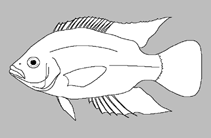
Ραχιαίες άκανθες (συνολικά) : 16 - 17; Μαλακές ραχιαίες ακτίνες (συνολικά) : 9 - 10; Εδρικές άκανθες: 6 - 8; Μαλακές εδρικές ακτίνες: 8 - 9; Σπόνδυλοι: 26. Can be diagnosed from species of the A. facetus, A. forquilha, A. kaaygua and A. scitulus species groups, and from A. acaroides, A. ykeregua, A. angiru and A. taura by having 12 caudal vertebrae (vs. 13 - 15) and 14 precaudal vertebrae (vs. 12 - 13); from species of the A. facetus, A. forquilha and A. kaaygua species groups by having three abdominal bars in all stages of life (vs. always four abdominal bars in juveniles, and adults with three bars in about 50% and four in about 50% of all specimens examined); from A. perdi by having 26 total vertebrae (vs. 25); from A. ykeregua by the absence of dark marks on the suborbital region (vs. presence); from A. agiru by having a conspicuous rounded caudal-fin base spot (vs. spot very narrow or absent); from all its congeners of the A. autrani species group by having anal-fin base squamation beginning at the third anal-fin spine (vs. anal-fin base squamation beginning at the sixth anal-fin spine); from A. autrani, A. barbosae, A. ipatinguensis, A. macaensis, A. macacuensis, A. muriae, A. paraibae, A. robustus, A. saquarema and A. montanus by having fewer proximal radials on anal-fin base (12 in A. mattosi vs. 13 in A. ipatinguensis, A. macacuensis, A. robustus and A. montanus; 13 - 14 in A. autrani, A. barbosae, A. macaensis, A. muriae and A. paraibae; and 14 - 15 in A. saquarema); from A. tavaresi by having mouth isognathous (vs. prognathous); and from A. ribeirae by having last dorsal-fin spine shorter (last dorsal-fin spine length 13.2 - 15.4% SL vs. 16.0 - 16.8% SL) (Ref. 89866).
Body shape (shape guide): elongated.
Κύκλος ζωής και συμπεριφορά ζευγαρώματος
Γεννητική Ωρίμανση | Αναπαραγωγή | Γεννοβολία | Αβγά | Γονιμότητα | Προνύμφες
Ottoni, F.P., 2012. Three new species of Australoheros from southeastern Brazil, with taxonomic notes on Chromys oblonga, Heros autochton and H. jenynsii (Teleostei: Labroidei: Cichlidae). Vertebrate Zoology 62(1):83-96. (Ref. 89866)
Κατάσταση Κόκκινου Καταλόγου IUCN (Ref. 130435: Version 2025-2 (Global))
Απειλή για τον άνθρωπο
Harmless
Ανθρώπινες χρήσεις
Εργαλεία
Ειδικές εκθέσεις
Λήψη XML
Διαδικτυακές πηγές
Εκτιμήσεις βάσει μοντέλων
Δείκτης φυλογενετικής ποικιλότητας (Αναφ.
82804): PD
50 = 0.5000 [Uniqueness, from 0.5 = low to 2.0 = high].
Bayesian length-weight: a=0.01380 (0.00714 - 0.02668), b=3.21 (3.05 - 3.37), in cm total length, based on LWR estimates for this species & (Sub)family-body (Ref.
93245).
Τροφικό Επίπεδο (Αναφ.
69278): 3.2 ±0.5 se; based on size and trophs of closest relatives
Ευπάθεια στην αλιεία (Ref.
59153): Low vulnerability (10 of 100).
🛈