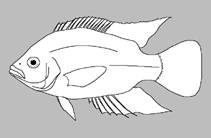
Classificatie / Namen
Lokale namen | Synoniemen | Catalog of Fishes(Genus, Soort(en)) | ITIS | CoL | WoRMS | Cloffa
>
Cichliformes (Cichlids, convict blennies) >
Cichlidae (Cichlids) > Cichlinae
Etymology: Australoheros: From the Latin word 'australis' meaning southern, and the name Heros, after the nominotypic genus of the Heroini tribe.
Tribe; montanus: From the Latin montanus, in allusion to the mountainous relief of the region where the new species inhabits (Ref. 89866).
Milieu: milieu / Klimaatzone / Diepte / verspreidingsgebied
Ecologie
; zoet water pelagisch. Tropical
South America: Rio Paquequer drainage, rio Paraíba do Sul basin in Rio de Janeiro, Brazil
Grootte / Gewicht / Leeftijd
Maturiteit: Lm ? range ? - ? cm
Max length : 10.3 cm SL mannelijk / geslacht onbekend; (Ref. 89866)
Korte beschrijving
Determinatiesleutels | Morfologie | Morfometrie
Dorsale stekels (totaal) : 15 - 17; Dorsale zachte stralen (totaal) : 10 - 11; Anale stekels: 6 - 8; Anale zachte stralen: 8 - 9; Wervels: 26. Can be diagnosed from species of the A. facetus, A. forquilha, A. kaaygua and A. scitulus species groups, and from A. acaroides, A. ykeregua, A. angiru and A. taura by having 12 caudal vertebrae (vs. 13 - 15) and 14 precaudal vertebrae (vs. 12 - 13); from species of the A. facetus, A. forquilha and A. kaaygua species groups by having three abdominal bars in all stages of life (vs. always four abdominal bars in juveniles, and adults with three bars in about 50% and four in about 50% of all specimens examined); from A. perdi by having 26 total vertebrae (vs. 25); from A. ykeregua by the absence of dark marks on the suborbital region (vs. presence); from A. agiru by having a conspicuous rounded caudal-fin base spot (vs. spot very narrow or absent); from all its congeners of the A. autrani species group (except A. macacuensis) by having posterior arm of trunk bar 7 wider than anterior one (vs. arms with the same width) from A. autrani, A. capixaba, A. macacuensis, A. macaensis, A. saquarema and A. ribeirae by having a complete red bar on posterior margin of caudal fin (vs. absence of red regions on caudal fin in A. autrani, A. capixaba, A. macacuensis, A. macaensis, A. saquarema and A. ribeirae; and two red regions on posterior margin of caudal-fin, one dorsal corner and other ventral corner in A. robustus and A. paraibae); from A. saquarema, A. muriae, A. robustus, A. barbosae, A. macacuensis, A. ipatinguensis, A. paraibae and A. ribeirae by having a longer caudal pedulce (caudal pedulce length 10.1 - 11.9 % SL in A. montanus sp. n. vs. 6.6 - 8.0% SL in A. ipatinguensis, 6.7 - 9.0% SL in A. saquarema, 5.1 - 7.9% SL in A. macacuensis, 5.5 - 8.7% SL in A. barbosae, 7.1 - 8.9% SL in A. muriae, 6.4 - 8.1% SL in A. paraibae, 7.4 - 9.2% SL in A. robustus and 6.6 - 9.1 % SL in A. ribeirae); from A. macaensis and A. saquarema by not having depression on snout (vs. depression on snout present in specimens above 30.0 mm SL, just above eyes); from A. macacuensis by having fewer teeth along posterior margin of ceratobranchial 5 (22 - 24 vs. 25 - 29); from A. macacuensis, A. macaensis and A. autrani by having trunk bars usually forked ventrally (vs. never forked ventrally); from A. mattosi by having anal-fin base squamation beginning at the sixth anal-fin spine (vs. anal-fin base squamation beginning at the third anal-fin spine); from A. tavaresi by having mouth isognathous (vs. prognathous) (Ref. 89866).
Levenscyclus en paargedrag
Maturiteit | Voortplanting | Paaien | Eieren | Fecunditeit | Larven
Ottoni, F.P., 2012. Three new species of Australoheros from southeastern Brazil, with taxonomic notes on Chromys oblonga, Heros autochton and H. jenynsii (Teleostei: Labroidei: Cichlidae). Vertebrate Zoology 62(1):83-96. (Ref. 89866)
Status op de Rode Lijst van het IUCN (Ref. 130435: Version 2025-2 (Global))
Gevaar voor de mens
Harmless
Gebruik door de mens
Tools
Speciale rapporten
Download XML
Internetbronnen
Schattingen op basis van modellen
Fylogenetische diversiteitsindex (Ref.
82804): PD
50 = 0.5000 [Uniqueness, from 0.5 = low to 2.0 = high].
Bayesian length-weight: a=0.01445 (0.00665 - 0.03141), b=3.08 (2.90 - 3.26), in cm total length, based on LWR estimates for this (Sub)family-body shape (Ref.
93245).
Trofisch niveau (Ref.
69278): 3.2 ±0.5 se; based on size and trophs of closest relatives
Weerstandsvermogen (Ref.
120179): Hoog, minimale populatieverdubbelingstijd minder dan 15 maanden (Preliminary K or Fecundity.).
Kwetsbaarheid van de visserij (Ref.
59153): Low vulnerability (10 of 100).
🛈