>
Perciformes/Serranoidei (Groupers) >
Grammistidae (Soapfishes)
Etymology: Rypticus: Greek, ryptikos, -e, -on = easy to wash (Ref. 45335); carpenteri: Named for Michael Carpenter, station manager for the Smithsonian’s research station at Carrie
Bow Cay, Belize.
Eponymy: Michael Carpenter was station manager for the Smithsonian’s research station at CarrieBow Cay, Belize, for over three decades. [...] (Ref. 128868), visit book page.
Entorno: milieu / zona climática / rango de profundidad / gama de distribución
Ecología
marino asociado a arrecife; rango de profundidad 0 - 40 m (Ref. 89885), usually 6 - 30 m (Ref. 89885). Tropical
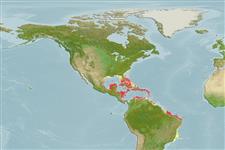
Western Central Atlantic: Caribbean.
Tamaño / Peso / Edad
Madurez: Lm ? range ? - ? cm
Max length : 8.6 cm SL macho / no sexado; (Ref. 89885)
Descripción breve
Claves de identificación | Morfología | Morfometría
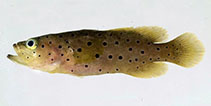
Espinas dorsales (total) : 3 - 4; Radios blandos dorsales (total) : 24 - 26; Espinas anales: 1; Radios blandos anales: 13 - 15. This species is distinguished from its congeners by the following unique set of characters: pectoral fin and distal portions of soft dorsal, caudal, and anal fins are pale yellow to yellow in life, pale in preservative; numerous dark spots on head and trunk, size of spots variable but those on head posterior to horizontal through center of orbit almost always smaller than pupil; interorbital region usually with 2 dark spots at posterior end, spots set slightly apart from orbital rim; belly with dark spots; caudal fin and sometimes soft dorsal and anal fins often with at least a few, sometimes tiny, dark spots; dorsal-fin spines 3 or 4 (almost always 4); total dorsal-fin elements modally 25; pectoral-fin rays modally 15; total caudal-fin rays modally 23; lower jaw extending anteriorly beyond upper jaw, mean difference between distance from tip of lower jaw to orbit and tip of upper jaw to orbit 5% head length (HL); relatively narrow caudal peduncle, average depth 11% SL (Ref. 89885).
Inhabits clear tropical, mean maximum depth of collected specimens was 17 m, only 6 specimens were collected at depths less than 5 m. This species lives among coral or rocks on steep slopes, vertical walls, or in other areas with large vertical relief, however, a few specimens have been taken among coral heads in shallow flat areas (Ref. 89885).
Ciclo vital y comportamiento de apareamiento
Madurez | Reproducción | Puesta | Huevos | Fecundidad | Larva
Baldwin, C.C. and L.A. Weigt, 2012. A new species of soapfish (Teleostei: Serranidae: Rypticus), with redescription of R. subbifrenatus and comments on the use of DNA barcoding in systematic studies. Copeia 2012(1):23-36. (Ref. 89885)
Situación en la Lista Roja de la UICN (Ref. 130435: Version 2025-2 (Global))
Amenaza para el ser humano
Harmless
Usos humanos
Pesquerías: sin interés
Herramientas
Informes especiales
Descargar XML
Fuentes de Internet
Estimaciones basadas en modelos
Temperatura preferida (Referencia
123201): 25.4 - 28, mean 27.2 °C (based on 236 cells).
Índice de diversidad filogenética (Referencia
82804): PD
50 = 0.5005 [Uniqueness, from 0.5 = low to 2.0 = high].
Bayesian length-weight: a=0.00427 (0.00160 - 0.01136), b=3.17 (2.95 - 3.39), in cm total length, based on LWR estimates for this (Sub)family-body shape (Ref.
93245).
Nivel trófico (Referencia
69278): 3.6 ±0.6 se; based on size and trophs of closest relatives
Vulnerabilidad pesquera (Ref.
59153): Low vulnerability (10 of 100).
🛈
Nutrientes (Ref.
124155): Calcium = 117 [60, 237] mg/100g; Iron = 0.811 [0.408, 1.472] mg/100g; Protein = 18.4 [16.6, 20.2] %; Omega3 = 0.198 [0.114, 0.341] g/100g; Selenium = 23.4 [11.4, 47.0] μg/100g; VitaminA = 180 [55, 627] μg/100g; Zinc = 1.67 [1.08, 2.52] mg/100g (wet weight);