>
Eupercaria/misc (Various families in series Eupercaria) >
Labridae (Wrasses) > Julidinae
Etymology: Coris: Greek, kore, -es = pupil and also with themenaing of "maid" (Ref. 45335).
More on author: Fowler.
Umwelt: Milieu / Klimazone / Tiefenbereich / Verbreitungsgebiet
Ökologie
seewasser riff-verbunden; tiefenbereich 2 - 40 m (Ref. 37816). Tropical
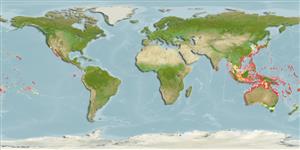
Western Pacific: Sagami Bay, Honshu south to Victoria, Australia and New Caledonia and east to Tonga.
Größe / Gewicht / Alter
Geschlechtsreife: Lm ? range ? - ? cm
Max length : 38.0 cm TL Männchen/unbestimmt; (Ref. 90102)
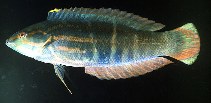
Rückenflossenstacheln (insgesamt) : 9; Rückenflossenweichstrahlen (insgesamt) : 12; Afterflossenstacheln: 3; Afterflossenweichstrahlen: 12. Body greenish with pink longitudinal lines and white barring (Ref. 48636). Body greenish with several red stripes breaking into spots posteriorly and about 8 thin vertical pale bars. A black spot rimmed with yellow on posterior margin of opercle. A black spot at posterior basal portion of dorsal fin. First 2 dorsal-fin spines with flexible tips slightly longer than other dorsal-fin spines (Ref 9823).
Body shape (shape guide): fusiform / normal; Cross section: compressed.
Found in coastal to outer reef habitats in deep gutters or along reef margins (Ref. 48636). Inhabits rocky and coral reefs, in areas with rubble, weed and sand (Ref. 9710). Found solitary (Ref. 90102).
Lebenszyklus und Paarungsverhalten
Geschlechtsreife | Fortpflanzung | Ablaichen | Eier | Fruchtbarkeit | Larven
Oviparous, with distinct pairing during breeding (Ref. 205).
Randall, J.E., 1999. Revision of the Indo-Pacific labrid fishes of the genus Coris, with descriptions of five new species. Indo-Pac. Fish. (29):74 p. (Ref. 33411)
IUCN Rote Liste Status (Ref. 130435: Version 2025-2 (Global))
Bedrohung für Menschen
Harmless
Nutzung durch Menschen
Fischereien: kommerziell; Aquarium: Kommerziell
Tools
Zusatzinformationen
Download XML
Internet Quellen
Schätzungen auf der Grundlage von Modellen
Bevorzugte Temperatur (Ref.
123201): 22.4 - 28.9, mean 27.5 °C (based on 532 cells).
Phylogenetischer Diversitätsindex (Ref.
82804): PD
50 = 0.5000 [Uniqueness, from 0.5 = low to 2.0 = high].
Bayesian length-weight: a=0.00977 (0.00468 - 0.02039), b=3.07 (2.90 - 3.24), in cm total length, based on LWR estimates for this (Sub)family-body shape (Ref.
93245).
Trophische Ebene (Ref.
69278): 3.5 ±0.3 se; based on size and trophs of closest relatives
Widerstandsfähigkeit (Ref.
120179): mittel, Verdopplung der Population dauert 1,4 - 4,4 Jahre. (Preliminary K or Fecundity.).
Anfälligkeit der Fischerei (Ref.
59153): Low to moderate vulnerability (28 of 100).
🛈
Nährstoffe (Ref.
124155): Calcium = 37.2 [14.6, 100.6] mg/100g; Iron = 0.558 [0.333, 0.989] mg/100g; Protein = 18.6 [15.7, 20.8] %; Omega3 = 0.127 [0.064, 0.249] g/100g; Selenium = 32 [12, 89] μg/100g; VitaminA = 102 [33, 353] μg/100g; Zinc = 1.87 [0.88, 3.36] mg/100g (wet weight);