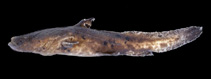
Classification / Noms
Noms communs | Synonymes | Catalog of Fishes(Genre, Espèce) | ITIS | CoL | WoRMS | Cloffa
>
Siluriformes (Catfishes) >
Chacidae (Squarehead or angler catfish)
Etymology: Chaca: Because of the sound that this fish makes when out of water (Ref. 45335); serica: Name from the Latin adjective sericus meaning made of silk, or silken, in allusion to the smooth oral margin of the lower lip when compared to Chaca bankanensis, the congener that it superficially resembles most.
More on authors: Ng & Kottelat.
Environnement : milieu / zone climatique / profondeur / gamme de distribution
Écologie
; eau douce démersal. Tropical
Asia: Barito, Kahayan, Kapuas (not to be confused with the larger river with an identical name in western Borneo) and the Mentaya river drainages in southern Borneo.
Taille / Poids / Âge
Maturité: Lm ? range ? - ? cm
Max length : 14.5 cm SL mâle / non sexé; (Ref. 89888)
Description synthétique
Clés d'identification | Morphologie | Morphométrie
Épines dorsales (Total) : 1; Rayons mous dorsaux (Total) : 4; Vertèbres: 33 - 35. Distinguished from Chaca bankanensis by the absence (vs. presence) of a series of rugose ridges on the oral margin of the lower lip, and by having generally longer dorsal and ventral procurrent caudal-ray bases (32.8-37.3% SL vs. 29.4-32.8 and 16.0-19.2% SL vs. 13.6-16.3 respectively), and from both Chaca burmensis and Chaca chaca in having (vs. lacking) nasal barbels, four pectoral-fin rays (vs. five), and lacking (vs. having) a row of
fimbriate skin flaps on the body dorsal to (and sometimes ventral to) the lateral line. Further differs from Chaca burmensis by the presence (vs. absence) of papillae around the eyes, a temporal fossa extending (vs. not extending) to the supraoccipital, and fewer serrae on the anterior edge of the pectoral spine (7-8 vs. 11-19) (Ref. 89888)
Cycle de vie et comportement reproducteur
Maturité | Reproduction | Frai | Œufs | Fécondité | Larves
Ng, H.H. and M. Kottelat, 2012. Chaca serica, a new species of frogmouth catfish (Teleostei: Siluriformes) from southern Borneo. Zootaxa 3258:37-45. (Ref. 89888)
Statut dans la liste rouge de l'IUCN (Ref. 130435: Version 2025-2 (Global))
Menace pour l'homme
Harmless
Utilisations par l'homme
Outils
Articles particuliers
Télécharger en XML
Sources Internet
Estimations basées sur des modèles
Indice de diversité phylogénétique (Réf.
82804): PD
50 = 0.6250 [Uniqueness, from 0.5 = low to 2.0 = high].
Bayesian length-weight: a=0.00389 (0.00180 - 0.00842), b=3.12 (2.94 - 3.30), in cm total length, based on all LWR estimates for this body shape (Ref.
93245).
Niveau trophique (Réf.
69278): 4.1 ±0.7 se; based on size and trophs of closest relatives
Vulnérabilité de la pêche (Ref.
59153): Low vulnerability (10 of 100).
🛈