Classificação / Nomes
Nomes comuns | Sinônimos | Catalog of Fishes(Gênero, Espécies) | ITIS | CoL | WoRMS | Cloffa
>
Siluriformes (Catfishes) >
Loricariidae (Armored catfishes) > Loricariinae
Etymology: janmoli: Named for the Dutch ecologist Jan H. Mol for his strong personal investment in the knowledge and protection of Harttiella, especially in Suriname where he recovered the highly vulnerable Harttiella crassicauda.
Eponymy: Charles Frederick Hartt (1840–1878) was a Canadian geologist, palaeontologist and naturalist, who was a member of the Thayer Expedition (1865–1866) to Brazil, a country in which he was a specialist. [...] Dr Jan H A Mol is a Dutch ecologist based at Anton de Kom University of Suriname where he is Professor of Aquatic Ecology. [...] (Ref. 128868), visit book page.
Meio ambiente: milieu / Zona climática / intervalo de profundidade / faixa de distribuição
Ecologia
; Água doce demersal. Tropical
South America: Known only from type locality in French Guiana, in a small forest creek of the Kotika Mountains at an altitude of 515 m.
Tamanho / Peso / Idade
Maturidade: Lm ? range ? - ? cm
Max length : 4.7 cm SL macho/indeterminado; (Ref. 90209)
Descrição suscinta
Chaves de identificação | Morfologia | Morfometria
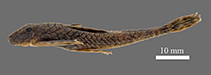
Raios dorsais (total) : 7; Espinhos anais: 1; Raios anais : 5. Distinguished from all other species of Harttiella by its dark brown coloration with a large
transverse postdorsal saddle corresponding to the position in congeners of the third and fourth bands posterior to dorsal- fin origin (vs. brownish normally with five postdorsal bands). Differs further from other species by having the following morphometric characters: longer pectoral spines [mean = 27.14 ± 1.54% of SL vs 21.14 ± 0.98 < mean < 24.06 ± 0.84% of SL); longer pelvic spines [mean = 24.67 ± 1.46% of SL vs 19.36 ± 1.17 < mean < 22.86 ± 1.64% of SL); a greater anus to pelvic-fin origin length [mean = 12.88 ± 0.96% of SL vs 9.29 ± 1.42 < mean < 11.31 ± 1.01% of SL); anus to pectoral-fin origin length [mean = 34.24 ± 1.67% of SL vs 28.38 ± 2.75 < mean < 31.85 ± 2.26% of SL); and anus to tip of snout length (mean = 49.81 ± 1.63% of SL vs 43.32 ± 1.42 < mean < 48.09 ± 1.93% of SL; a wider body at dorsal-fin origin [mean = 23.46 ± 1.18% of SL vs 17.28 ± 1.11 < mean < 20.06 ± 1.61% of SL); and a deeper body at dorsal-fin origin [mean = 14.80 ± 1.14% of SL vs 9.86 ± 0.79 < mean < 11.41 ± 1.41% of SL) (Ref. 90209).
Body shape (shape guide): elongated.
Ciclo de vida ou comportamento de acasalamento
Maturidade | Reprodução | Desova | Ovos | Fecundidade | Larvas
Covain, R., S. Fisch-Muller, J.I. Montoya-Burgos, J.H. Mol, P.-Y. Le Bail and S. Day, 2012. The Harttiini (Siluriformes, Loricariidae) from the Guianas: a multi-table approach to assess their diversity, evolution, and distribution. Cybium 36(1):115-161. (Ref. 90209)
Status na Lista Vermelha da UICN (Ref. 130435: Version 2025-2 (Global))
Ameaça para os humanos
Harmless
Uso pelos humanos
Ferramentas
Relatórios especiais
Baixar XML
Fontes da internet
Estimativas baseadas em modelos
Índice de diversidade filogenética (Ref.
82804): PD
50 = 0.5078 [Uniqueness, from 0.5 = low to 2.0 = high].
Bayesian length-weight: a=0.00398 (0.00185 - 0.00857), b=3.11 (2.93 - 3.29), in cm total length, based on LWR estimates for this (Sub)family-body shape (Ref.
93245).
Nível Trófico (Ref.
69278): 2.8 ±0.2 se; based on size and trophs of closest relatives
Vulnerabilidade da pesca (Ref.
59153): Low vulnerability (10 of 100).
🛈