Environnement : milieu / zone climatique / profondeur / gamme de distribution
Écologie
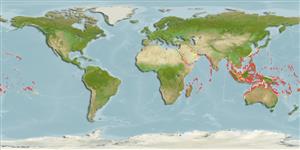
marin récifal; profondeur 0 - 30 m (Ref. 4319), usually 6 - ? m (Ref. 37816). Tropical; 33°N - 31°S, 30°E - 130°W (Ref. 5222)
Indo-West Pacific: none have been taken on the African coast, except for the specimen recorded by Randall and Heemstra 1991(Ref. 4787) from Kenyan coast north of Kilifi Creek. It is an insular species found in most tropical Indo-Pacific islands. Absent in the Red Sea and Persian Gulf.
Longueur à la première maturité / Taille / Poids / Âge
Maturité: Lm 19.0 range ? - ? cm
Max length : 27.5 cm TL mâle / non sexé; (Ref. 48600)
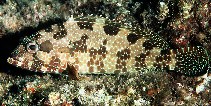
Épines dorsales (Total) : 11; Rayons mous dorsaux (Total) : 15 - 17; Épines anales: 3; Rayons mous anaux: 8. This species is distinguished by the following characters: body depth 2.8-3.5 in SL (10-17 cm SL individuals); head length 2.5-2.6 in SL; preopercle rounded, ventral serrae slightly enlarged; upper edge of operculum convex; midlateral part of lower jaw with 3-5 rows of teeth; gill rakers of first gill arch 7-9 + 17-19; dorsal spines 5th-9th subequal (2.5-2.8 in HL); second anal spine 2.1-2.5 in HL, distinctly longer than third spine or depth of peduncle; caudal fin rounded; pectoral-fin rays 17-19, fin length 1.6-1.9 in HL; pelvic fins 1.8-2.1 in HL; lateral-line scales 61-70; lateral scale series 93 to 114. Colour: head and body covered with polygonal (mostly hexagonal) brown spots that tend to merge, leaving only conspicuous triangular white dots at corners of the polygons; dark spots on belly and ventral part of head more rounded and separated, and often reddish brown; 4 or 5 brownish black saddle blotches (formed by groups of darker spots) on dorsal part of body and caudal peduncle, the first 4 extending onto base of dorsal fin; irregular dark bar, formed by darker polygonal spots, on lower part of body below each saddle blotch; large brown or olive spot just behind eye, often joined to similar spot on opercle; fins with close-set dark brown or reddish brown spots and white dots, except distal half of pectoral fins with faint dark spots and no white dots; pelvic and anal fins with pale edge and dark brown submarginal band; interspinous dorsal-fin membranes with dark brown triangle and short white or pale yellow filament behind tip of each spine (Ref. 39231, 90102).
Body shape (shape guide): fusiform / normal; Cross section: compressed.
Common in exposed outer-reef areas in relatively shallow water. Well-camouflaged grouper, solitary (Ref 37816). Feeds mainly on fishes and crustaceans (stomatopods and brachyuran crabs) (Ref. 5222). This fish is too small to be of commercial importance except as a food fish in artisanal fisheries. It is caught with hook-and-line, traps, spear, and gill nets (Ref. 39231).
Cycle de vie et comportement reproducteur
Maturité | Reproduction | Frai | Œufs | Fécondité | Larves
Heemstra, P.C. and J.E. Randall, 1993. FAO Species Catalogue. Vol. 16. Groupers of the world (family Serranidae, subfamily Epinephelinae). An annotated and illustrated catalogue of the grouper, rockcod, hind, coral grouper and lyretail species known to date. Rome: FAO. FAO Fish. Synop. 125(16):382 p. (Ref. 5222)
Statut dans la liste rouge de l'IUCN (Ref. 130435: Version 2025-2 (Global))
Menace pour l'homme
Reports of ciguatera poisoning (Ref. 130160)
Utilisations par l'homme
Pêcheries: intérêt commercial mineur; pêche sportive: oui
Outils
Articles particuliers
Télécharger en XML
Sources Internet
Estimations basées sur des modèles
Température préférée (Réf.
123201): 25.1 - 29.3, mean 28.4 °C (based on 2803 cells).
Indice de diversité phylogénétique (Réf.
82804): PD
50 = 0.5000 [Uniqueness, from 0.5 = low to 2.0 = high].
Bayesian length-weight: a=0.00933 (0.00533 - 0.01633), b=3.00 (2.86 - 3.14), in cm total length, based on LWR estimates for this species & Genus-body shape (Ref.
93245).
Niveau trophique (Réf.
69278): 4.1 ±0.67 se; based on food items.
Generation time: 1.2 ( na - na) years. Estimated as median ln(3)/K based on 1
growth studies.
Résilience (Réf.
120179): Haut, temps minimum de doublement de population inférieur à 15 mois (K=0.9).
Vulnérabilité de la pêche (Ref.
59153): Low vulnerability (17 of 100).
🛈
Nutriments (Ref.
124155): Calcium = 59 [29, 126] mg/100g; Iron = 0.799 [0.403, 1.710] mg/100g; Protein = 18.6 [17.0, 20.0] %; Omega3 = 0.134 [0.080, 0.220] g/100g; Selenium = 30.6 [15.4, 60.6] μg/100g; VitaminA = 247 [61, 950] μg/100g; Zinc = 1.41 [0.91, 2.09] mg/100g (wet weight);