>
Perciformes/Notothenioidei (Icefishes) >
Channichthyidae (Crocodile icefishes)
Etymology: Channichthys: Greek, channe, -es = an anchovy + Greek, ichthys = fish (Ref. 45335); richardsoni: Named for the Scottish naturalist John Richardson, who described the first species of icefishes C. rhinoceratus and established the genus Channichthys.
Eponymy: Sir John Richardson (1787–1865) was a Scottish naval surgeon, naturalist and Arctic explorer. [...] (Ref. 128868), visit book page.
Environnement : milieu / zone climatique / profondeur / gamme de distribution
Écologie
marin démersal; profondeur 126 - 310 m (Ref. 90862), usually 126 - ? m (Ref. 90862). Deep-water
Southern Ocean, Sub-Antarctic: Kerguelen Islands.
Taille / Poids / Âge
Maturité: Lm ? range ? - ? cm
Max length : 37.4 cm TL (female)
Description synthétique
Clés d'identification | Morphologie | Morphométrie
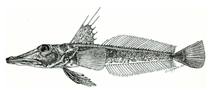
Épines dorsales (Total) : 7 - 8; Rayons mous dorsaux (Total) : 31 - 34; Épines anales: 0; Rayons mous anaux: 29 - 32. This species is characterized by the following D1 VII-VIII, D2 31-34; A 29-32; pectoral 19-20; bony tubular plates (scales) of the dorsal lateral line 61-78 and of the median lateral line 9-23, rounded separated bony plates in the anterior part of the median lateral line 4-28, as a rule, more than 10; number of gill-rakers on the outer side of the lower part of the 1st arch 6-15. This species is further distinguished by the following: interorbital width narrow, 1.0-1.4 times in horizontal orbit diameter, 5.8-7.5 in HL and 2.0-2.4 in head height at level of middle of eye; eye moderate in size, its diameter 5.2-6.3 times in HL and 2.6-3.0 in snout length; supraorbital outer bony edges of frontals noticeably elevated; snout relatively long, approximately equal to or somewhat shorter than half the head length, 2.1-2.2 in HL; tips of jaws aligned or lower jaw slightly protruding, teeth on symphysis not visible; posterior edge of maxillary extending below 1/3-1/2 of the orbit diameter; a row of rakers on lower part of first gill arch on the outer side of ceratobranchial; pectoral fin extending above to anus or origin of first anal fin ray; first dorsal fin high, 3.3-4.7 times in SL, second and third rays longest; fin membrane of D1 not reaching tips of longest rays, its height about 1.4-1.7 times in height of D1; dorsal fins well separated, posterior edge of D1 fin membrane not reaching first ray base of D2; interdorsal distance wide, 10.9-16.4 times in SL or 1.0-1.9 times in length of D1; bony tuberculation well developed on frontals and lacrimals, D1 flexible spines, branchiostegals, pelvic fins and on bony structures of both lateral lines; absent on maxillary and on anterior part of lower jaw (Ref. 90862).
Body shape (shape guide): elongated.
Found on shelf waters of islands and caught in 2 bottom trawls at depths of 126 and 270-310 m, together with C. rhinoceratus, C. rugosus, C. panticapaei, C. bospori, C. irinae and C. mithridatis. Most specimens were caught at depth of 126 m in an area with abundant benthic fauna and the alga Macrocystis pyrifera. Apparently a primarily piscivorous predator (inferred from the single row of gill-rakers and similar to its congeners). Females mature at about 29-31 cm TL (25-27 cm SL); the post-spawning SGM VI-III is clearly detected in females larger than 31 cm TL and the SGM III - in the smaller, firstly maturing ones. The SGM of the males examined varied from stage II to early stage III in the specimen of 32.5 cm TL. Spawning and pre-spawning SGM were absent. Spawning period apparently takes a place from autumn to the beginning of winter (Ref. 90862).
Cycle de vie et comportement reproducteur
Maturité | Reproduction | Frai | Œufs | Fécondité | Larves
Shandikov, G.A., 2011. Channichthys richardsoni sp. n., a new Antarctic icefish (Perciformes: Notothenioidei: Channichthyidae) from the Kerguelen Islands area, Indian sector of the Southern Ocean. Journal of V.N. Karazin Kharkiv National University, Series: Biology 2008, 7(814):125-134. (Ref. 90862)
Statut dans la liste rouge de l'IUCN (Ref. 130435: Version 2025-2 (Global))
Menace pour l'homme
Harmless
Utilisations par l'homme
Pêcheries: bycatch
Outils
Articles particuliers
Télécharger en XML
Sources Internet
Estimations basées sur des modèles
Indice de diversité phylogénétique (Réf.
82804): PD
50 = 0.5020 [Uniqueness, from 0.5 = low to 2.0 = high].
Bayesian length-weight: a=0.00129 (0.00059 - 0.00280), b=3.46 (3.28 - 3.64), in cm total length, based on LWR estimates for this (Sub)family-body shape (Ref.
93245).
Niveau trophique (Réf.
69278): 3.7 ±0.6 se; based on size and trophs of closest relatives
Résilience (Réf.
120179): Milieu, temps minimum de doublement de population : 1,4 à 4,4 années (Preliminary K or Fecundity.).
Vulnérabilité de la pêche (Ref.
59153): Low to moderate vulnerability (27 of 100).
🛈