Entorno: milieu / zona climática / rango de profundidad / gama de distribución
Ecología
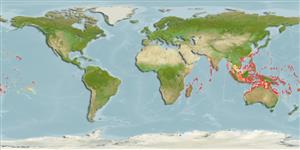
marino asociado a arrecife; rango de profundidad 3 - 44 m (Ref. 90102). Tropical; 30°N - 33°S, 30°E - 137°W (Ref. 5222)
Indo-Pacific: Kenya south to Natal, South Africa and east to the central Pacific. Unknown from the Red Sea, Persian Gulf, and Hawaii. Recorded from Europa Island (MNHN 1992-0498, Ref. 33390). Often confused with Epinephelus quoyanus, Epinephelus faveatus, Epinephelus corallicola, and Epinephelus howlandi.
Tamaño / Peso / Edad
Madurez: Lm ? range ? - ? cm
Max length : 51.0 cm TL macho / no sexado; (Ref. 4787); peso máximo publicado: 2.0 kg (Ref. 5222)
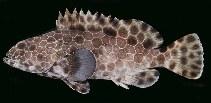
Espinas dorsales (total) : 11; Radios blandos dorsales (total) : 15 - 17; Espinas anales: 3; Radios blandos anales: 8. Head profile angular; body less compressed and spots more closely spaced than E. corallicola and E. howlandi (Ref. 37816). Body and median fins with large dark blotches, largest towards the tail (Ref. 48635); further characterized by pale greyish color; head, body and fins with well-spaced dark brown to orange brown spots of unequal size; soft dorsal, anal and caudal fins with narrow white to yellow margin; lower part of head and breast with white blotches; 3-4 black blotches along back; body scales cycloid except ctenoid on lower region below pectoral fins; body with numerous auxiliary scales; greatest depth of body 2.9-3.6 in SL; rounded caudal fin; pelvic fins 1.8-2.4 in head length (Ref. 90102); head length 2.3-2.6 times in SL; flat or slightly concave interorbital area, dorsal head profile of adults with ventral bend at orbits; rounded preopercle, minute serrae mostly covered by skin and shallow indentation just above the angle; straight or slightly convex upper edge of operculum posterior nostril distinctly larger than anterior nostril; maxilla reaches to or past vertical at rear edge of orbit, ventral edge smoothly curved at distal expansion; strongly projecting lower jaw, 2-4 rows of teeth at midlateral part (Ref. 89707).
Body shape (shape guide): fusiform / normal; Cross section: compressed.
Found in lagoon and seaward reefs (Ref. 9710) to a depth of at least 44 m; including outer reef slopes. More abundant on oceanic reefs and rare on coastal reefs (Ref. 89707). Feeds on crustaceans (mainly crabs), fishes, octopi, and squid. Solitary (Ref 90102).
Ciclo vital y comportamiento de apareamiento
Madurez | Reproducción | Puesta | Huevos | Fecundidad | Larva
Heemstra, P.C. and J.E. Randall, 1993. FAO Species Catalogue. Vol. 16. Groupers of the world (family Serranidae, subfamily Epinephelinae). An annotated and illustrated catalogue of the grouper, rockcod, hind, coral grouper and lyretail species known to date. Rome: FAO. FAO Fish. Synop. 125(16):382 p. (Ref. 5222)
Situación en la Lista Roja de la UICN (Ref. 130435: Version 2025-2 (Global))
Amenaza para el ser humano
Harmless
Usos humanos
Pesquerías: comercial
Herramientas
Informes especiales
Descargar XML
Fuentes de Internet
Estimaciones basadas en modelos
Temperatura preferida (Referencia
123201): 24.7 - 29, mean 27.9 °C (based on 718 cells).
Índice de diversidad filogenética (Referencia
82804): PD
50 = 0.5000 [Uniqueness, from 0.5 = low to 2.0 = high].
Bayesian length-weight: a=0.01072 (0.00699 - 0.01642), b=3.05 (2.93 - 3.17), in cm total length, based on LWR estimates for this species & Genus-body shape (Ref.
93245).
Nivel trófico (Referencia
69278): 3.8 ±0.5 se; based on diet studies.
Resiliencia (Referencia
120179): Medio, población duplicada en un tiempo mínimo de 1.4-4.4 años (Preliminary K or Fecundity.).
Vulnerabilidad pesquera (Ref.
59153): Moderate vulnerability (40 of 100).
🛈
Nutrientes (Ref.
124155): Calcium = 28.4 [13.9, 60.3] mg/100g; Iron = 0.484 [0.265, 0.991] mg/100g; Protein = 18.5 [17.0, 19.9] %; Omega3 = 0.118 [0.074, 0.185] g/100g; Selenium = 32.3 [19.5, 56.8] μg/100g; VitaminA = 189 [53, 675] μg/100g; Zinc = 1.34 [0.94, 1.86] mg/100g (wet weight);