Classificazione / Nomi
Nomi Comuni | Sinonimi | Catalog of Fishes(Genere, Specie) | ITIS | CoL | WoRMS | Cloffa
>
Characiformes (Characins) >
Lebiasinidae (Pencilfishes) > Lebiasininae
Etymology: Lebiasina: Derived from Greek, lebias, lebiou = a kind of fish (Ref. 45335); melanoguttata: The specific name 'melanoguttata' is derived from melan, meaning black and guttata, meaning dotted. This is in reference to the longitudinal series of dark blotches present along the flanks of Lebiasina melanoguttata. An adjective.
Ambiente: milieu / zona climatica / distribuzione batimetrica / gamma di distribuzione
Ecologia
; acqua dolce benthopelagico. Tropical
South America: Rio Curuá (rio Xingu basin) in Serra do Cachimbo, Brazil.
Dimensione / Peso / Età
Maturità: Lm ? range ? - ? cm
Max length : 6.8 cm SL maschio/sesso non determinato; (Ref. 91748)
Breve descrizione
Chiavi di identificazione | Morfologia | Morfometria
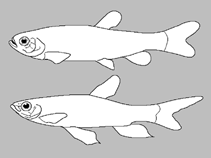
Raggi dorsali molli (totale) : 10; Raggi anali molli: 11 - 12. Can be easily diagnosed from all lebiasinins, except for Lebiasina minuta, by the following characters: absence of the primary and secondary stripes, and the caudal blotch; the presence of three longitudinal series of dark blotches at the base of the scales; the pair of foramina on the vomer through which the ramus palatinus of the facial nerve runs; the large laminar extrascapular bone in contact with the fifth infraorbital, and overlaying the anterodorsal portion of the opercle; and nearly equal caudal-fin lobes. Can be separated from Lebiasina minuta by the absence of a dark blotch at the base of the median rays of the dorsalfin, the presence of conical teeth on the second infrapharyngobranchial, the reddish overall coloration of the eye and fins, and the dark blotches of longitudinal series 3 and 4 which never coalesce (vs. a dark blotch present at the base of the median rays of the dorsal-fin; the second infrapharyngobranchial being edentulous; a yellowish overall color of body, and the dark, olive green eyes; and the dark blotches of longitudinal series 3 and 4 coalescing where scales of adjacent longitudinal series overlap) (Ref. 91748).
Body shape (shape guide): elongated.
Facultative air-breathing in the genus (Ref. 126274)
Ciclo vitale e comportamento di accoppiamento
Maturità | Riproduzione | Deposizione | Uova | Fecondità | Larve
Netto-Ferreira, A.L., 2012. Three new species of Lebiasina (Characiformes: Lebiasinidae) from the Brazilian Shield border at Serra do Cachimbo, Pará, Brazil. Neotrop. Ichthyol. 10(3):487-498. (Ref. 91748)
Stato della Lista Rossa IUCN (Ref. 130435: Version 2025-2 (Global))
Minaccia per l'uomo
Harmless
Usi umani
Strumenti
Rapporti speciali
Scarica XML
Fonti Internet
Stime basate su modelli
Indice di diversità filogenetica (Fonte Biblio.
82804): PD
50 = 0.5000 [Uniqueness, from 0.5 = low to 2.0 = high].
Bayesian length-weight: a=0.00692 (0.00276 - 0.01737), b=3.05 (2.83 - 3.27), in cm total length, based on LWR estimates for this (Sub)family-body shape (Ref.
93245).
Livello trofico (Fonte Biblio.
69278): 3.4 ±0.4 se; based on size and trophs of closest relatives
Vulnerabilità della pesca (Ref.
59153): Low vulnerability (10 of 100).
🛈