>
Perciformes/Serranoidei (Groupers) >
Liopropomatidae (Painted basslets) > Liopropomatinae
Etymology: Liopropoma: Greek, leio = smooth + Greek, pro = in front of + Greek, poma, -atos = cover, operculum (Ref. 45335); emanueli: Named for Emanuel d’Oliveira.
Eponymy: Emanuel Charles D’Oliveira (d: 1958) is a PE teacher and professional diver as well as a recreational diving instructor. [...] (Ref. 128868), visit book page.
Môi trường: môi trường / vùng khí hậu / Mức độ sâu / phạm vi phân phối
Sinh thái học
biển cùng sống ở rạn san hô; mức độ sâu 20 - 32 m (Ref. 91766). Subtropical
Eastern Atlantic, Cape Verde Islands.
Bộ gần gũi / Khối lượng (Trọng lượng) / Tuổi
Chín muồi sinh dục: Lm ? range ? - ? cm
Max length : 12.4 cm SL con đực/không giới tính; (Ref. 91766); 10.2 cm SL (female)
Mô tả ngắn gọn
Khóa để định loại | Hình thái học | Sinh trắc học
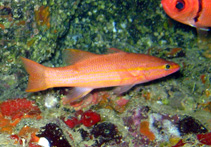
Các tia vây lưng cứng (tổng cộng) : 8; Các vây lưng mềm (tổng cộng) : 11; Tia cứng vây hậu môn: 3; Tia mềm vây hậu môn: 8. This species is distinguished by the following characters: D VI?I?I+11; seventh dorsal spine embedded and scaled over, the first dorsal spine minute, both are only visible in the radiographs; sixth dorsal spine clearly visible above interdorsal ridge; 16 pectoral rays; about 54 lateral-line scales (only countable in holotype); approx. 4?5+1+8?11 gill rakers; inner teeth at front of jaws and side of lower jaw substantially longer than teeth in outer row; posterior margin of upper central part of preopercle is irregular, finely serrated; pink ground coloration, with broad yellow-orange stripe from snout through eye along the midlateral part of flanks; numerous thinner yellow-orange stripes above and below this central stripe, slightly irregular on opercle and tail; yellow-orange caudal fin's upper and lower margin, the dorsal margin of softray dorsal fin and lower margin of anal fin; caudal fin slightly emarginate (Ref. 91766).
Body shape (shape guide): fusiform / normal; Cross section: compressed.
Encountered in front of a vertical wall covered with the sun coral Tubastrea aurea, at 36 m depth. It retreated into one of the many small (bucket to bathtub-sized) caves in this wall. During later dives, several other individuals were encountered along the same vertical wall, but additional individuals were later also seen in other areas, consisting of large boulders overgrown with black coral (Antipathella and Tanacetipathes species.). They retreated below these boulders when approached. The most common species in the same area were the soldier fishes Myripristis jacobus Cuvier, 1829 and Sargocentron hastatum (Cuvier, 1829); and Corniger spinosus Agassiz, 1831, was also seen at the vertical Tubastrea wall (Ref. 91766).
Vòng đời và hành vi giao phối
Chín muồi sinh dục | Sự tái sinh sản | Đẻ trứng | Các trứng | Sự sinh sản | Ấu trùng
Wirtz, P. and U.K. Schliewen, 2012. A new species of Liopropoma Gill, 1862 from the Cape Verde Islands, Eastern Atlantic (Teleostei, Perciformes, Serranidae). Spixiana 35(1):149-154. (Ref. 91766)
Tình trạng Sách đỏ IUCN (Ref. 130435: Version 2025-2 (Global))
Mối đe dọa đối với con người
Harmless
Sử dụng của con người
Các công cụ
Báo cáo đặc biệt
Tải xuống XML
Các nguồn internet
Ước tính dựa trên mô hình
Chỉ số đa dạng phát sinh loài (Tài liệu tham khảo
82804): PD
50 = 0.5000 [Uniqueness, from 0.5 = low to 2.0 = high].
Bayesian length-weight: a=0.01122 (0.00514 - 0.02450), b=3.04 (2.87 - 3.21), in cm total length, based on all LWR estimates for this body shape (Ref.
93245).
Mức dinh dưỡng (Tài liệu tham khảo
69278): 3.9 ±0.6 se; based on size and trophs of closest relatives
Sự dễ bị tổn thương của nghề đánh cá (Ref.
59153): Low vulnerability (10 of 100).
🛈