Miljö: miljö / Klimatzon / djupintervall / distributionsområde
Ekologi
marina djupbottenlevande; djupintervall 900 - 1225 m (Ref. 92304). Polar; 71°S - 73°S, 177°E - 178°W (Ref. 92304)
Antarctic Pacific: Ross Sea.
Storlek / Vikt / Ålder
Könsmognad: Lm ? range ? - ? cm
Max length : 23.4 cm SL hane/ej könsbestämd; (Ref. 92304); 26.0 cm SL (female)
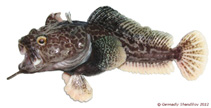
This species is distinguished by the following characters: first dorsal fin with 2 flexible spines; second dorsal fin with 27-28 rays; anal fin with 17-18 rays; pectoral fins with 19-20 rays; gill rakers: anterior 9-12, posterior 7-9, total 17-21; upper lateral line with 25-27 pores (tubular scales); middle lateral line with 12-16 pores (tubular scales); cephalic lateral line pores: preoperculo-mandibular canal 9; infraorbital canal 7; supraorbital 4, with 2 nasal and 2 interorbital pores; coronal commissure 1 central pore; temporal 6; supratemporal 2, disrupted at middle, with 1 left and 1 right pores; vertebrae: 16 + 22 = 38. A dorsally-spotted and short-barbeled species of Pogonophryne distinguished from others in the 'P. mentella' group by a combination of: a short (about 10-12% SL), fine and somewhat tapering mental barbel, flattened and pointed just the tip, dorsally bi-colored: dark-spotted or uniformly dark-colored stem with very small light tip of barbel ('terminal expansion'), reaching slightly beyond anterior edge of orbit in backward extended mode over the snout with mouth closed; distal part of mental barbel covered by densely distributed, closely adjacent to stem dark finger-like processes; almost undetectable by eye flat and light, short terminal expansion (about 18-29% of barbel length) composed of independent leaf-like processes or/and low longitudinal folds bearing prominent serrated leaf-like processes; interorbital distance wide (about 7% SL); lower jaw slightly protruding with not visible teeth on symphysis when mouth closed; teeth on both jaws sharp and conical, slightly retrorse, somewhat enlarged on tips of jaws in posterior rows: 2-3 irregular rows on symphysis of lower jaw and 3 rows anteriorly on upper jaw; second dorsal fin low (up to 18% SL), without anterior elevated lobe in adult males, with light-greenish ground coloration, variegated by inconspicuous oblique stripes and blotches generally distributed on rays; anal and both sides of pelvic fins generally light, without contrast bicolor pigmentation: creamy-whitish distally (partly with light-pinkish tinge) and somewhat variegated by inconspicuous longitudinal brownish stripes and blotches basally; pectoral fins with about 10-11 dark vertical stripes alternating by turquoise-greenish stripes; narrow distal margin of fins uniformly light-greenish; caudal fin with light-greenish ground coloration and with about 6-7 dark vertical stripes, not extending to narrow uniformly light-greenish distal margin of fin; dorsal surface of head and area anterior to first dorsal fin covered by large irregular dark-brown markings and spots; breast and belly dark-brown and blackish, both lacking in evident dark sharp spots or markings; mandibular oral valve dark-pigmented anteriorly, maxillar oral valve lighter; oral cavity generally light (Ref. 92304).
Body shape (shape guide): elongated; Cross section: oval.
A deep-water species collected by bottom long-line at depths (726?)900-1,225(1,568?) m by hooks baited with large pieces (about 4x3x2 cm) of giant Peruvian squid, Dosidicus gigas. Predatory species, which also opportunistically feeds as necrophage. Spawning probably take place in November - December. In post-spawning female (paratype, 31.5 cm TL, captured at 12 January 2010) the length, width and depth of ovary attain about 35-38, 11-12 and 6-7 mm correspondently. The GSI reaches about 0.8. State of gonad maturity, affirmed by presence of ovarian cavity and empty follicles, provide the evidence of post-spawning SGM VI-III and recently finished spawning. The diameter of 10 measured oocytes of trophoplasmatic growth of younger generation varied from 0.24 to 0.49 mm (average 0.37 mm, SD=0.08). Paired well developed testes of male (holotype, 29 cm TL, captured at 11 January 2010) reach about 45-49 mm in length, 12-14 mm in width and 3-4 mm in depth; GSI about 0.5; SGM apparently corresponds to early post-spawning stage VI or VI-II. In the smaller male (28 cm TL, captured at 20 January 2010) visual appearance of undeveloped testes (length 35, width 2.5, depth 1 mm) and low GSI (0.06), apparently corresponding to SGM II-III, evidence on subadult male, which could spawn for the first time the next season. Liver large, filling about 1/2-2/3 of the length of the abdominal cavity, creamy in coloration; hepatosomatic index reaches 2.4-6.4. A nematode larva of the genus Pseudoterranova sp. (family. Anisakidae) was found on the surface of the liver (Ref. 92304).
Livscykel och parningsbeteende
Könsmognad | Reproduktion | Lek | Ägg | Fekunditet | Larver
Shandikov, G.A., R.R. Eakin and S. Usachev, 2013. Pogonophryne tronio, a new species of Antarctic short-barbeled plunderfish (Perciformes: Notothenioidei: Artedidraconidae) from the deep Ross Sea with new data on Pogonophryne brevibarbata. Polar Biol. 36(2):273-289. (Ref. 92304)
Status på IUCN:s rödlista (Ref. 130435: Version 2025-2 (Global))
Hot mot människor
Harmless
Mänskliga användningsområden
Verktyg
Särskilda rapporter
Ladda ner XML
Internet-källor
Uppskattningar baserade på modeller
Index för fylogenetisk mångfald (Ref.
82804): PD
50 = 0.5000 [Uniqueness, from 0.5 = low to 2.0 = high].
Bayesian length-weight: a=0.00513 (0.00244 - 0.01080), b=3.13 (2.95 - 3.31), in cm total length, based on LWR estimates for this (Sub)family-body shape (Ref.
93245).
Trofisk nivå (Ref.
69278): 3.3 ±0.5 se; based on size and trophs of closest relatives
Sårbarhet i fisket (Ref.
59153): Low vulnerability (22 of 100).
🛈