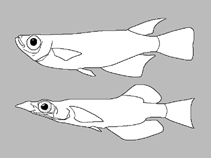
التصنيف / الأسماء
الأسماء الشائعة | مرادفات | Catalog of Fishes(جنس, الانواع) | ITIS | CoL | WoRMS | Cloffa
>
Beloniformes (Needle fishes) >
Adrianichthyidae (Ricefishes) > Oryziinae
Etymology: Oryzias: Greek, oryza = rice; because of the habitat used by this fish (Ref. 45335); eversi: Named for Hans-Georg Evers who discovered this endemic ricefi sh while travelling to explore fishes and habitats in Sulawesi.
Eponymy: Hans-Georg Evers (d: 1964) is a German aquarist based in Hamburg. [...] (Ref. 128868), visit book page.
البيئة: الوسط / المنطقة المناخية / نطاق العمق / نطاق التوزيع
البيئة
; المياه العذبة قاعية التغذية و المعيشة. Tropical; 22°C - ? (Ref. 91779)
Asia: Tana Toraja in Sulawesi, Indonesia.
الحجم / وزن / العمر
النضج: Lm ? range ? - ? cm
Max length : 3.6 cm SL ذكر/ مختلط الجنس; (Ref. 91779); 3.8 cm SL (female)
وصف مختصر
مفاتيح التعريف | الوصف الخارجي | قياسات المظهر الخارجي
الأشعة الظهرية الناعمة (المجموع) : 10 - 12; أشعه شرجية لينه: 17 - 18; فقرات: 30 - 32. Can be diagnosed from all other species belonging to Adrianichthyidae in Sulawesi by the following combination of characters: anal fin with 17-18 fin rays; dorsal fin with 10-12 rays; lateral midline with 33-36 scales; ½14 transverse scale rows at dorsal fin origin; total vertebrae 30-32; small eye size relative to head length (28.2-35.5% HL); absence of dark bluish or steel blue body coloration or brilliant red marks in both sexes; conspicuous blackish courtship coloration of males, including a blackish belly and posterior lateral body, presence of 6-9 blackish lateral bars, and presence of a narrow black line on a light brown background on dorsal surface; principal caudal fin with I,4/5,I rays; and a conspicuous pelvic brooding behavior associated with sexually dimorphic body depth and pelvic fi n length (Ref. 91779).
Body shape (shape guide): elongated.
The type locality where the species occurs is a karst pond of 30-40 m length, up to 10 m width and approximately up to 4 m depth, with calm and crystal clear water, with single in- and outflow and surrounded by rain forest. The pond is used by local people as a natural swimming pool (Ref. 91779). A pelvic-brooder, in which females carry an egg cluster until hatching (Ref. 126777).
دورة الحياة وسلوك التزاوج
النضج | التكاثر | وضع البيض | بيض | الخصوبة | اليرقات
A pelvic-brooder which carries clusters of eggs in a belly concavity until they hatch (Ref. 91779).
Herder, F., R.K. Hadiaty and A.W. Nolte, 2012. Pelvic-fin brooding in a new species of riverine ricefish (Atherinomorpha: Beloniformes: Adrianichthyidae) from Tana Toraja, Central Sulawesi, Indonesia. The Raffles Bulletin of Zoology 60(2):467-476. (Ref. 91779)
حالة القائمة الحمراء للاتحاد الدولي لحفظ الطبيعة والموارد الطبيعية (Ref. 130435: Version 2025-2 (Global))
استخدامات بشرية
مصائد: غير ذات اهمية
أدوات
تقارير خاصة
تنزيل XML
مصادر علي الأنترنت
تقديرات تستند إلى النماذج
مؤشر التنوع الشُعبي الوراثي (مرجع
82804): PD
50 = 0.5000 [Uniqueness, from 0.5 = low to 2.0 = high].
Bayesian length-weight: a=0.00479 (0.00190 - 0.01207), b=3.13 (2.91 - 3.35), in cm total length, based on LWR estimates for this (Sub)family-body shape (Ref.
93245).
مستوى غذائي (مرجع
69278): 3.4 ±0.4 se; based on size and trophs of closest relatives
ضعف الصيد (Ref.
59153): Low vulnerability (10 of 100).
🛈