Classification / Noms
Noms communs | Synonymes | Catalog of Fishes(Genre, Espèce) | ITIS | CoL | WoRMS | Cloffa
>
Characiformes (Characins) >
Hemiodontidae (Halftooths)
Etymology: Hemiodus: Greek, hemi = half + Greek, odous = teeth (Ref. 45335); langeanii: Named for Dr. Francisco Langeani, for his highly relevant contributions to the knowledge of hemiodontid fishes.
Eponymy: Dr Francisco Langeani Neto is a Brazilian ichthyologist who specialises in Neotropical fish at Universidade Estadual Paulista, Instituto de Biociências, Letras e Ciências Exatas, where he is an adjunct professor. [...] (Ref. 128868), visit book page.
Environnement : milieu / zone climatique / profondeur / gamme de distribution
Écologie
; eau douce benthopélagique; pH range: 6.4 - 6.8. Tropical; 26°C - 28°C (Ref. 91067)
South America: known of the type locality in the rio Amana, rio Maués-Açu drainage, near the boundary of the States of Pará and Amazonas, Brazil
Taille / Poids / Âge
Maturité: Lm ? range ? - ? cm
Max length : 13.6 cm SL mâle / non sexé; (Ref. 91067)
Description synthétique
Clés d'identification | Morphologie | Morphométrie
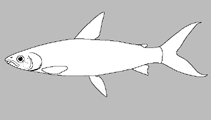
Rayons mous dorsaux (Total) : 11 - 12; Rayons mous anaux: 11 - 13; Vertèbres: 36. Distinguished from other species of Hemiodus by its high body (27.1-35.3%, average 32.3% SL vs. 18.8-28.5% in remaining species). Other diagnostic characters include the following: presence of a large lateral dark spot that is equal to, or greater than, the eye diameter (vs. smaller in remaining species except for Hemiodus microlepis); absence of conspicuous lateral stripe or transverse bands; 68-74 scales on lateral line (vs. 94-123 in Hemiodus argenteus, 124-148 in Hemiodus microlepis, 86-99 in Hemiodus orthonops and 77-92 in Hemiodus parnaguae). Differs from Hemiodus unimaculatus (which overlaps in the number of lateral line scales) by having 9-10 scales between the lateral line and the pelvic fin origin (vs. 4-7), which are similar sized above and below lateral line (vs. scales larger bellow the lateral line in Hemiodus unimaculatus) (Ref. 91067).
Found in slow-flowing stretches of the rio Amana and igarapé Porquinho (1.0-2.5 m deep) and in artificial ponds (4.0-5.0 m deep and 40-70 m in diameter) resulting from gold-mining activities. The Rio Amana and its tributaries are characterized by clear water (not stained by humic acids) but turbid due to excess of fine suspended solids (clay) as a result of mining activities along river margins and/or bottom such as dredging (Ref. 91067).
Cycle de vie et comportement reproducteur
Maturité | Reproduction | Frai | Œufs | Fécondité | Larves
Beltrão, H. and J. Zuanon, 2012. Hemiodus langeanii (Characiformes: Hemiodontidae), a new species from rio Amana, rio Maués-Açú drainage, Amazon basin, Brazil. Neotrop. Ichthyol. 10(2):255-262. (Ref. 91067)
Statut dans la liste rouge de l'IUCN (Ref. 130435: Version 2025-2 (Global))
Menace pour l'homme
Harmless
Utilisations par l'homme
Outils
Articles particuliers
Télécharger en XML
Sources Internet
Estimations basées sur des modèles
Indice de diversité phylogénétique (Réf.
82804): PD
50 = 0.5000 [Uniqueness, from 0.5 = low to 2.0 = high].
Bayesian length-weight: a=0.00537 (0.00256 - 0.01126), b=3.13 (2.95 - 3.31), in cm total length, based on LWR estimates for this (Sub)family-body shape (Ref.
93245).
Niveau trophique (Réf.
69278): 2.7 ±0.3 se; based on size and trophs of closest relatives
Vulnérabilité de la pêche (Ref.
59153): Low vulnerability (10 of 100).
🛈