>
Gobiiformes (Gobies) >
Gobiidae (Gobies) > Gobiinae
Etymology: Amblygobius: Greek, amblys = darkness + Latin gobius = gudgeon (Ref. 45335).
More on author: Rüppell.
Environnement : milieu / zone climatique / profondeur / gamme de distribution
Écologie
marin; saumâtre récifal; non migrateur (Ref. 52884); profondeur 10 - 20 m (Ref. 100374). Tropical; 22°C - 30°C (Ref. 27115)
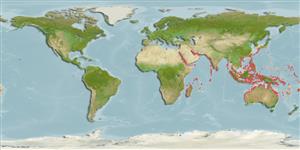
Indo-West Pacific: Red Sea and East Africa south to Durban (South Africa), including most islands in the western Indian Ocean islands; Indonesia, Australia and South Pacific islands. Also known from Japan, Philippines (Ref. 2798) and Persian Gulf (Ref. 68964)
Taille / Poids / Âge
Maturité: Lm ? range ? - ? cm
Max length : 18.0 cm SL mâle / non sexé; (Ref. 2798)
Description synthétique
Clés d'identification | Morphologie | Morphométrie
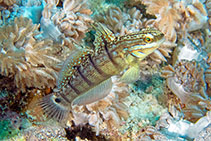
Épines dorsales (Total) : 7; Rayons mous dorsaux (Total) : 13 - 15; Épines anales: 1; Rayons mous anaux: 12 - 14. Males with 3 black spots near base of 2nd dorsal fin and round spots on cheek; females with brown-edged band from upper lip to upper operculum (Ref. 2798).
Body shape (shape guide): fusiform / normal.
Adults are epibenthic and littoral, entering estuaries and lagoons (Ref. 4343). Usually seen in pairs, hovering a short distance above the substratum. Monogamous (Ref. 52884). It builds its burrow in sand or silty sand by moving out mouthfuls of sediment (Ref. 11441). Maximum depth reported taken from Ref. 9773.
Cycle de vie et comportement reproducteur
Maturité | Reproduction | Frai | Œufs | Fécondité | Larves
Monogamous mating is observed as both obigate and social (Ref. 52884).
Maugé, L.A., 1986. Gobiidae. p. 358-388. In J. Daget, J.-P. Gosse and D.F.E. Thys van den Audenaerde (eds.) Check-list of the freshwater fishes of Africa (CLOFFA). ISNB, Brussels; MRAC, Tervuren; and ORSTOM, Paris. Vol. 2. (Ref. 4343)
Statut dans la liste rouge de l'IUCN (Ref. 130435: Version 2025-2 (Global))
Menace pour l'homme
Harmless
Utilisations par l'homme
Pêcheries: commercial; Aquarium: Commercial
Outils
Articles particuliers
Télécharger en XML
Sources Internet
Estimations basées sur des modèles
Température préférée (Réf.
123201): 24.6 - 29.3, mean 28.4 °C (based on 3100 cells).
Indice de diversité phylogénétique (Réf.
82804): PD
50 = 0.5000 [Uniqueness, from 0.5 = low to 2.0 = high].
Bayesian length-weight: a=0.01023 (0.00477 - 0.02194), b=3.01 (2.83 - 3.19), in cm total length, based on LWR estimates for this (Sub)family-body shape (Ref.
93245).
Niveau trophique (Réf.
69278): 3.3 ±0.06 se; based on food items.
Résilience (Réf.
120179): Milieu, temps minimum de doublement de population : 1,4 à 4,4 années (Preliminary K or Fecundity.).
Vulnérabilité de la pêche (Ref.
59153): Low vulnerability (12 of 100).
🛈
Nutriments (Ref.
124155): Calcium = 74.8 [39.3, 146.8] mg/100g; Iron = 0.625 [0.318, 1.120] mg/100g; Protein = 19 [17, 21] %; Omega3 = 0.137 [0.063, 0.247] g/100g; Selenium = 17.2 [8.9, 34.0] μg/100g; VitaminA = 126 [34, 424] μg/100g; Zinc = 1.77 [1.20, 2.59] mg/100g (wet weight);