Классификация / Имена
народные названия | синонимы | Catalog of Fishes(род, виды) | ITIS | CoL | WoRMS | Cloffa
>
Characiformes (Characins) >
Anostomidae (Headstanders)
Etymology: Megaleporinus: Name from Greek 'mega' meaning large or largest, plus Leporinus, the genus which most species (now in this genus) were previously assigned; refrring to the large size of most congeners; piavussu: The specific name piavussu is in reference to the common name of the species in upper Rio
Paraná basin, 'piavuçu' or 'piavussu', which in indigenous language is a compound name meaning 'piava', term used to designate fishes of the genus Leporinus , and 'ussu' ou 'uçu' a radical that means big, that is, a big sized Leporinus species.
Окружающая среда: среда / климатическая зона / пределы глубины / диапазон распространения
экология
; пресноводный донно-пелагический. Tropical
South America: endemic to the upper Rio Paraná, Brazil.
Размер / Вес / Возраст
половая зрелость: Lm ? range ? - ? cm
Max length : 38.0 cm SL самец/пол неопределен; (Ref. 93038)
Краткое описание
определительные ключи | морфология | морфометрия
членистые (мягкие) лучи спинного плавника (общее число) : 12; членистые (мягкие) лучи анального плавника: 10 - 13. Distinguished from all species of Leporinus except, L.amblyrhynchus, L. conirostris, L. desmotes , L. despaxi, L. elongatus , L. jatuncochi , L.macrocephalus, L. muyscorum, L. obtusidens, L. reinhardti, L. trifasciatus and L. wolfei, by possessing three teeth on premaxilla and dentary (vs. tooth formulae 3/4, 4/4 or 4/3). Can be separated from from L. amblyrhynchus, L. conirostris, L. desmotes, L. despaxi, L. jatuncochi, L. macrocephalus, L. muyscorum, L. reinhardti, L. trifasciatus, and L. wolfei by having three dark rounded blotches on the body and dark transverse bars usually persistent in large specimens (vs. body with a dark midlateral stripe in L. amblyrhynchus, and L. despaxi; transverse dark bands in L. desmotes and L. jatuncochi; body pale except for a single dark blotch on caudal peduncle in L. conirostris; first blotch, below the dorsal fin, transversely elongated in L. macrocephalus, L. trifasciatus and L. wolfei; transverse bars faded in large specimens of L. muyscorum; and blotch on the caudal peduncle longitudinally elongated, not rounded, sometimes making contact with the second blotch in L. reinhardti). Differs from L. elongatus by having 16 circumpeduncular scale rows (vs.12); from very similar species L. obtusidens by having 39 to 40, exceptionally 41, perforated scales on the lateral line (vs. 41 to 43, rarely 44). Individuals of Leporinus piavussu particularly discriminate from individuals of L. piavussu from the upper Rio Paraná basin by having a terminal mouth, its cleft above the horizontal through the ventral orbital margin (vs. mouth directed somewhat or entirely downward, its cleft at the horizontal through the ventral orbital margin or below) (Ref. 93038).
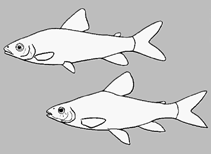
Body shape (shape guide): elongated.
Distinct pairs breed on densely grown weedy places (Ref. 205).
Жизненный цикл и брачное поведение
половая зрелость | размножение | нерест | икра | Плодовитость | личинки
Distinct pairs breed on densely grown weedy places (Ref. 205).
Ramirez, J.L., J.L.O. Birindelli and P.M. Galetti Jr., 2017. A new genus of Anostomidae (Ostariophysi: Characiformes): Diversity, phylogeny and biogeography based on cytogenetic, molecular and morphological data. Molecular Phylogenetics and Evolution, 107: 308-323. (Ref. 113781)
Статус Красного Списка МСОП (Ref. 130435: Version 2025-2 (Global))
Угроза для людей
Harmless
Использование человеком
дополнительная информация
инструменты
Специальные отчеты
Скачать в формате XML
ресурсы в Интернет
Оценки, основанные на моделях
Индекс филогенетического разнообразия (ссылка
82804): PD
50 = 0.5010 [Uniqueness, from 0.5 = low to 2.0 = high].
Bayesian length-weight: a=0.00933 (0.00435 - 0.02001), b=3.05 (2.88 - 3.22), in cm total length, based on LWR estimates for this Genus-body shape (Ref.
93245).
Трофический уровень (ссылка
69278): 2.6 ±0.1 se; based on size and trophs of closest relatives
устойчивость к внешним воздействиям (ссылка
120179): средний (среднего размера), минимальное время удвоения популяции 1.4-4.4 года (Preliminary K or Fecundity.).
Уязвимость рыбной ловли (Ref.
59153): Moderate vulnerability (36 of 100).
🛈