Klassifizierung / Names
Namen | Synonyme | Catalog of Fishes(Gattung, Arten) | ITIS | CoL | WoRMS | Cloffa
>
Gobiiformes (Gobies) >
Oxudercidae (Mudskippers) > Periophthalminae
Etymology: Boleophthalmus: Name from Greek, ßoƛɛ for ejected and 'ophthalmos' for eye; refers to species capability to rapidly raise their eyes above the level of their orbital cavities, as if the eyes were being ejected; poti: Named came from the indigenous people of the Wapi villages of Purutu Island, the specie's type locality. They call this species ‘poti’, where in their language means ‘spotted’ and refers to the
numerous tiny whitish spots present on the head of this fish.
Umwelt: Milieu / Klimazone / Tiefenbereich / Verbreitungsgebiet
Ökologie
seewasser; süßwasser; brackwasser pelagic-neritic. Tropical
Western Pacific: Papua New Guinea.
Größe / Gewicht / Alter
Geschlechtsreife: Lm ? range ? - ? cm
Max length : 10.6 cm SL Männchen/unbestimmt; (Ref. 93058); 10.8 cm SL (female)
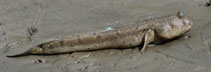
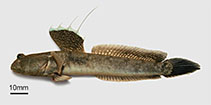
Rückenflossenstacheln (insgesamt) : 5; Rückenflossenweichstrahlen (insgesamt) : 23 - 26; Afterflossenweichstrahlen: 24 - 26. This species is similar to B. birdsongi and B. caeruleomaculatus in having unnotched, flattened and horizontally disposed dentary teeth. It differs from its congeners by having an elongate D1 fin spines, protruding from the fin margin (in both sexes) and having the following dorsal-fin colouration in live individuals: D1 with clearly demarcated sky-blue to whitish marginal band; interradial membranes of D1 greenish-brown, spotted with whitish to yellowish speckles, sometimes fused into broken, narrow and wavy lines; the interradial membranes of D2 are grey to pale brown, darker posteriorly, pale grey distally, with a very thin white margin and columns of 0-5 whitish spots between adjacent rays; and D2 rays are darker than interradial membranes (Ref. 93058).
Body shape (shape guide): elongated; Cross section: oval.
Facultative air-breathing (Ref. 126274); Specimens were collected by hand in tidally exposed burrows, seaward to the pneumatophore zones of pioneer mangrove shores dominated by Sonneratia caseolaris, and along mud banks of intertidal creeks (Ref. 93058).
Lebenszyklus und Paarungsverhalten
Geschlechtsreife | Fortpflanzung | Ablaichen | Eier | Fruchtbarkeit | Larven
Polgar, G., Z. Jaafar and P. Konstantinidis, 2013. A new species of mudskipper, Boleophthalmus poti (Teleostei: Gobiidae: Oxudercinae) from the Gulf of Papua, Papua New Guinea, and a key to the genus. Raffles Bull. Zool. 61(1):311-321. (Ref. 93058)
IUCN Rote Liste Status (Ref. 130435: Version 2025-2 (Global))
Bedrohung für Menschen
Harmless
Nutzung durch Menschen
Köder: usually
Tools
Zusatzinformationen
Download XML
Internet Quellen
Schätzungen auf der Grundlage von Modellen
Phylogenetischer Diversitätsindex (Ref.
82804): PD
50 = 0.5156 [Uniqueness, from 0.5 = low to 2.0 = high].
Bayesian length-weight: a=0.00708 (0.00321 - 0.01560), b=2.96 (2.77 - 3.15), in cm total length, based on LWR estimates for this (Sub)family-body shape (Ref.
93245).
Widerstandsfähigkeit (Ref.
120179): hoch, Verdopplung der Population dauert weniger als 15 Monate. (Preliminary K or Fecundity.).
Anfälligkeit der Fischerei (Ref.
59153): Low vulnerability (10 of 100).
🛈