>
Atheriniformes (Silversides) >
Atherinidae (Silversides) > Atherinomorinae
Etymology: Atherinomorus: Greek, atherina, the Greek name for the eperlane + Greek, moros = silly, stupid (Ref. 45335).
Eponymy: Dr Peter Forsskål (1732–1763) was a Swedish explorer, orientalist, naturalist and a student of Linnaeus. [...] (Ref. 128868), visit book page.
Ambiente: milieu / zona climatica / distribuzione batimetrica / gamma di distribuzione
Ecologia
marino associati a barriera corallina. Tropical
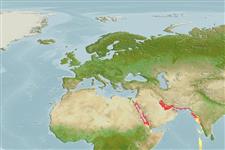
Western Indian Ocean: endemic to the Red Sea. Lessepsian migrant to Mediterranean Sea.
Dimensione / Peso / Età
Maturità: Lm ? range ? - ? cm
Max length : 13.3 cm SL maschio/sesso non determinato; (Ref. 58474)
Breve descrizione
Chiavi di identificazione | Morfologia | Morfometria
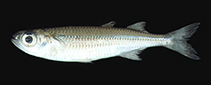
Spine dorsali (totale) : 5 - 7; Raggi dorsali molli (totale) : 8 - 10; Spine anali: 1; Raggi anali molli: 11 - 15; Vertebre: 40 - 44. This species is distinguished by the following set of characters: lateral process of premaxilla very low and wide; upper margin of dentary almost flat distally, no distinct tubercle at the posterior end; posterior tip of the upper jaw reaching to or exceeding a vertical through anterior margin of the pupil, and not reaching to a vertical through center of the pupil; teeth on endopterygoids large, forming distinct ridges; anus located around posterior tip of the pelvic fin; lower gill rakers 20-23; midlateral scale count 39-43; lower margin of midlateral band reaching to or just below ventral end of the midlateral (third) scale row at the level of the anal fin origin (Ref. 58474).
Body shape (shape guide): fusiform / normal; Cross section: compressed.
Feeds on zooplankton, small bottom-living invertebrates (Ref. 5980).
Ciclo vitale e comportamento di accoppiamento
Maturità | Riproduzione | Deposizione | Uova | Fecondità | Larve
Kimura, S., D. Golani, Y. Iwatsuki, M. Tabuchi and T. Yoshino, 2007. Redescriptions of the Indo-Pacific atherinid fishes Atherinomorus forskalii, Atherinomorus lacunosus, and Atherinomorus pinguis. Ichthyol. Res. 54(2):145-159. (Ref. 58474)
Stato della Lista Rossa IUCN (Ref. 130435: Version 2025-2 (Global))
Minaccia per l'uomo
Harmless
Usi umani
Strumenti
Rapporti speciali
Scarica XML
Fonti Internet
Stime basate su modelli
Temperatura preferita (Fonte Biblio.
123201): 24.7 - 29.4, mean 27.1 °C (based on 78 cells).
Indice di diversità filogenetica (Fonte Biblio.
82804): PD
50 = 0.5020 [Uniqueness, from 0.5 = low to 2.0 = high].
Bayesian length-weight: a=0.01122 (0.00514 - 0.02450), b=3.04 (2.87 - 3.21), in cm total length, based on all LWR estimates for this body shape (Ref.
93245).
Livello trofico (Fonte Biblio.
69278): 3.3 ±0.4 se; based on size and trophs of closest relatives
Resilienza (Fonte Biblio.
120179): Medio, tempo minimo di raddoppiamento della popolazione 1.4 - 4.4 anni (Preliminary K or Fecundity.).
Vulnerabilità della pesca (Ref.
59153): Low vulnerability (10 of 100).
🛈