Clasificación / Nombres
Nombres comunes | Sinónimos | Catalog of Fishes(Género, Especie) | ITIS | CoL | WoRMS | Cloffa
>
Cyprinodontiformes (Rivulines, killifishes and live bearers) >
Rivulidae (Rivulines) > Cynolebiinae
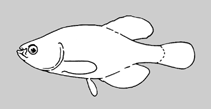
Etymology: pterophyllus: Name derived from the Greek pteron (wing) and phyllon (leaf), referring to long dorsal and anal fins in males, also an allusion to the superficial similarity with Pterophyllum scalare Lichtenstein, an Amazonian cichlid fish with long dorsal and anal and dark bars on body sides.
Entorno: milieu / zona climática / rango de profundidad / gama de distribución
Ecología
; agua dulce bentopelágico. Tropical
South America: São Francisco River basin, Brazil.
Tamaño / Peso / Edad
Madurez: Lm ? range ? - ? cm
Max length : 6.5 cm SL macho / no sexado; (Ref. 89836); 5.6 cm SL (female)
Descripción breve
Claves de identificación | Morfología | Morfometría
Radios blandos dorsales (total) : 15 - 24; Radios blandos anales: 18 - 24; Vértebra: 28 - 30. Distinguished from all other members of Hypsolebias flavicaudatus complex, except H. flagellatus and H. radiseriatus, by having more anal-fin filaments in males (6-8 vs. 4-5). Differs from H. flagellatus by having longer dorsal-fin base in males (36.0-41.4% SL vs. 41.4-45.3% SL) and yellow zone of anal fin in males restricted to the posterior portion of the fin (vs. occupying more than half horizontal length of fin), and from H. radiseriatus by the absence of a triangular bluish white spot on the antero-basal portion and short blue to golden lines of the distal portion of the dorsal fin in males (vs. presence). Can be further diagnosed from H. flavicaudatus, H. gilbertobrasili and H. guanambi by having short stripes on the anterior part of the dorsal fin in males (vs. dots); and from H. sertanejo, H. janaubensis and H. nitens by the absence of elongate spots on the postero-basal portion of the dorsal fin in males (vs. presence). Often distinguished from other congeners in having the dorsal and anal fins longer in males, with tips excluding filaments reaching middle of the caudal fin (vs. reaching basal portion of the fin) and seems to be the largest species of the H. flavicaudatus complex, with males often reaching between about 55 and 65 mm SL (vs. maximum size about 50 mm SL) (Ref. 89836).
Body shape (shape guide): short and / or deep.
Sympatric with Hypsolebias picturatus in some temporary pools along its entire geographical range (Ref. 89836).
Ciclo vital y comportamiento de apareamiento
Madurez | Reproducción | Puesta | Huevos | Fecundidad | Larva
Costa, W.J.E.M., P.F. Amorim and J.L. Mattos, 2012. Species delimitation in annual killifishes from the Brazilian Caatinga, the Hypsolebias flavicaudatus complex (Cypriniformes: Rivulidae): implications for taxonomy and conservation. Systematics and Biodiversity 10(1):71-91. (Ref. 89836)
Situación en la Lista Roja de la UICN (Ref. 130435: Version 2025-2 (Global))
Amenaza para el ser humano
Harmless
Usos humanos
Herramientas
Informes especiales
Descargar XML
Fuentes de Internet
Estimaciones basadas en modelos
Índice de diversidad filogenética (Referencia
82804): PD
50 = 0.5000 [Uniqueness, from 0.5 = low to 2.0 = high].
Bayesian length-weight: a=0.01995 (0.00906 - 0.04395), b=3.01 (2.83 - 3.19), in cm total length, based on all LWR estimates for this body shape (Ref.
93245).
Nivel trófico (Referencia
69278): 3.3 ±0.4 se; based on size and trophs of closest relatives
Resiliencia (Referencia
120179): Alto, población duplicada en un tiempo mínimo inferior a 15 meses (Preliminary K or Fecundity.).
Vulnerabilidad pesquera (Ref.
59153): Low vulnerability (10 of 100).
🛈