>
Gobiiformes (Gobies) >
Gobiidae (Gobies) > Gobiinae
Etymology: Acentrogobius: Greek, a = without + Greek, kentron = sting + Latin gobius = gudgeon (Ref. 45335); cenderawasih: Named after its type locality, Cenderawasih Bay, West Papua; noun in apposition.
Environnement : milieu / zone climatique / profondeur / gamme de distribution
Écologie
marin récifal; profondeur 0 - 30 m (Ref. 90102), usually 0 - 3 m (Ref. 90102). Tropical
Western Pacific: Indonesia.
Taille / Poids / Âge
Maturité: Lm ? range ? - ? cm
Max length : 3.9 cm SL (female)
Description synthétique
Clés d'identification | Morphologie | Morphométrie
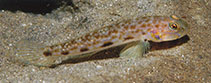
Épines dorsales (Total) : 6 - 7; Rayons mous dorsaux (Total) : 11; Épines anales: 1; Rayons mous anaux: 11; Vertèbres: 27. Characterized by pale grey body color with large, irregular brown blotches dorsally on head and upper half of body; five, horizontally elongate dark brown blotches arranged in a longitudinal row at side of body; generally translucent fins except white pelvics; upper and lower pectoral fin base with dark brown spot; dorsal rays VI+I,11, thin and flexible dorsal spines; anal rays I,11; pectoral rays 18; lanceolate caudal fin, longer than head length; pelvic fin rays I,5, frenum well developed; longitudinal scale series 32-33; transverse scales from origin of second dorsal fin ventroposteriorly to anal fin base 8; transverse scales from anal fin origin dorsoanteriorly to first dorsal fin base 9; predorsal scales 13-14; cycloid scales covering body; head without scales except dorsally and laterally on nape (Ref. 90102).
Body shape (shape guide): elongated; Cross section: oval.
Found in deep water, 18-30 m, frequent in very shallow water 0-3 m in highly protected near-shore environments, marine lakes and brackish estuaries (Ref. 90102).
Cycle de vie et comportement reproducteur
Maturité | Reproduction | Frai | Œufs | Fécondité | Larves
Allen, G.R. and M.V. Erdmann, 2012. Reef fishes of the East Indies. Perth, Australia: Universitiy of Hawai'i Press, Volumes I-III. Tropical Reef Research. (Ref. 90102)
Statut dans la liste rouge de l'IUCN (Ref. 130435: Version 2025-2 (Global))
Menace pour l'homme
Harmless
Utilisations par l'homme
Outils
Articles particuliers
Télécharger en XML
Sources Internet
Estimations basées sur des modèles
Indice de diversité phylogénétique (Réf.
82804): PD
50 = 0.5000 [Uniqueness, from 0.5 = low to 2.0 = high].
Bayesian length-weight: a=0.00794 (0.00340 - 0.01856), b=3.09 (2.91 - 3.27), in cm total length, based on LWR estimates for this Genus-body shape (Ref.
93245).
Niveau trophique (Réf.
69278): 3.2 ±0.4 se; based on size and trophs of closest relatives
Résilience (Réf.
120179): Haut, temps minimum de doublement de population inférieur à 15 mois (Preliminary K or Fecundity.).
Vulnérabilité de la pêche (Ref.
59153): Low vulnerability (10 of 100).
🛈