Ταξινόμηση / Ονόματα
Κοινά ονόματα | Συνώνυμα | Catalog of Fishes(Γένος, Είδη) | ITIS | CoL | WoRMS | Cloffa
>
Siluriformes (Catfishes) >
Trichomycteridae (Pencil or parasitic catfishes) > Trichomycterinae
Etymology: Trichomycterus: Greek, thrix = hair + Greek, mykter, -eros = nose (Ref. 45335); perkos: From the Greek adjective perkos (pe????), meaning “s spotted or streaked with black marks, in allusion to the color pattern of the new species formed by either dark stripes (small-sized specimens) or dark stripes combined with small spots (larger individuals).
Περιβάλλον: περιβάλλον / κλιματική ζώνη / εύρος βάθους / εύρος διανομής
Οικολογία
; Γλυκού νερού βενθικό(ς). Tropical
South America: tributaries of the Paranapanema and Uruguai River basins in southern Brazil.
Μέγεθος / Βάρος / Ηλικία
Γεννητική Ωρίμανση: Lm ? range ? - ? cm
Max length : 9.4 cm SL αρσενικό/απροσδιόριστο; (Ref. 90267)
Σύντομη περιγραφή
Κλείδες προσδιορισμού | Μορφολογία | Μορφομετρία
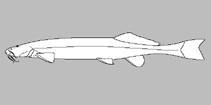
Ραχιαίες άκανθες (συνολικά) : 2; Μαλακές ραχιαίες ακτίνες (συνολικά) : 8 - 9; Εδρικές άκανθες: 2; Μαλακές εδρικές ακτίνες: 6 - 8. Large specimens of more than 65.8 mm SL, presumably adults, of Trichomycterus perkos can be diagnosed from all their congeners in having a remarkable coloration with melanophores arranged in two distinct skin layers, forming (1) a freckled pattern, with minute light brown spots scattered on the superficial tegumentar layer of the dorsum and caudal peduncle, and (2) a striped pattern, with three- sagittal, midlateral, and ventrolateral - wide, irregularly bordered, and sometimes interrupted dark brown stripes running along an inner skin layer of the trunk and caudal peduncle . Smaller specimens of less than 43.3 mm SL, presumably juveniles, of Trichomycterus perkos lack the superficial freckled pattern, but already exhibit the three wide dark stripes found in the adults.
Nevertheless, both juveniles and adults of T. perkos possess the following unequivocally morphological traits that distinguish them from other congeners: from T. duellmani in having modally seven pectoral-fin rays (vs. modally eight), two pores in the lateral line (vs. four), distal margin of the adpressed pelvic fin not reaching the anus (vs. distal margin extending posteriorly beyond the anus), modally ten branchiostegal rays (vs. six or seven), and modally 41 post-Weberian vertebrae (vs. 33-36); (2) from T. itatiayae by the first pectoral-fin ray not filamentous (vs. filamentous), distal margin of the adpressed pelvic fin not reaching the anus (vs. distal margin extending posteriorly beyond the anus), modally ten branchiostegal rays (vs. eight), and modally 41 post-Weberian vertebrae (vs. 35-37); (3) from T. nigroauratus by the first pectoral-fin ray not filamentous (vs. filamentous), modally seven pectoral-fin rays (vs. modally eight), modally ten branchiostegal rays (vs. seven or eight), and modally 41 post-Weberian vertebrae (vs. 35-36); (4) from T. pauciradiatus in having the first pectoral-fin ray not filamentous (vs. filamentous), modally seven pectoral- fin rays (vs. modally six), five pelvic-fin rays (vs. four), distal margin of the adpressed pelvic fin not reaching the anus (vs. distal margin extending posteriorly beyond the anus), pores i1 and i3 of the infraorbital laterosensory canal lacking (vs. i1 and i3 present), modally ten branchiostegal rays (vs. eight), and modally 41 post-Weberian vertebrae (vs. 36-38); (5) from T. reinhardti by the first pectoral-fin ray not prolonged as a filament (vs. ray filamentous), distal margin of the adpressed pelvic fin not reaching the anus (vs. distal margin extending posteriorly beyond the anus), absence of the pores i1 and i3 of the infraorbital laterosensory canal (vs. i1 and i3 present), modally ten branchiostegal rays (vs. seven or eight), and modally 41 post-Weberian vertebrae (vs. 38); and (6) from T. taenia by the first pectoral-fin ray not filamentous (vs. filamentous), and distal margin of the adpressed pelvic fin not reaching the anus (vs. distal margin reaching the anus) (Ref. 90267).
Body shape (shape guide): elongated.
Mostly found in clear water streams with 1 to 3 m wide, with bottoms composed of stone, gravel, and sand. Streamlets are usually surrounded by modified riparian vegetation (Ref. 90267).
Κύκλος ζωής και συμπεριφορά ζευγαρώματος
Γεννητική Ωρίμανση | Αναπαραγωγή | Γεννοβολία | Αβγά | Γονιμότητα | Προνύμφες
Datovo, A., M. Carvalho and J. Ferrer, 2012. A new species of the catfish genus Trichomycterus from the La Plata River basin, southern Brazil, with comments on its putative phylogenetic position (Siluriformes: Trichomycteridae). Zootaxa 3327:33-44. (Ref. 90267)
Κατάσταση Κόκκινου Καταλόγου IUCN (Ref. 130435: Version 2025-2 (Global))
Απειλή για τον άνθρωπο
Harmless
Ανθρώπινες χρήσεις
Εργαλεία
Ειδικές εκθέσεις
Λήψη XML
Διαδικτυακές πηγές
Εκτιμήσεις βάσει μοντέλων
Δείκτης φυλογενετικής ποικιλότητας (Αναφ.
82804): PD
50 = 0.5000 [Uniqueness, from 0.5 = low to 2.0 = high].
Bayesian length-weight: a=0.00912 (0.00396 - 0.02102), b=2.97 (2.79 - 3.15), in cm total length, based on LWR estimates for this Genus-body shape (Ref.
93245).
Τροφικό Επίπεδο (Αναφ.
69278): 3.2 ±0.4 se; based on size and trophs of closest relatives
Ευπάθεια στην αλιεία (Ref.
59153): Low vulnerability (10 of 100).
🛈