Classification / Noms
Noms communs | Synonymes | Catalog of Fishes(Genre, Espèce) | ITIS | CoL | WoRMS | Cloffa
>
Siluriformes (Catfishes) >
Trichomycteridae (Pencil or parasitic catfishes) > Potamoglanininae
Etymology: Potamoglanis: Derived from the Greek potamo, means river; the gods of rivers in the Greek mythology, and from glanis, means catfish; anhanga: Named for an Amazonian Anhangá legend, a spirit that lives in the woods, protector of animals. Its presence can be detected by a whistle and thereafter, the animal that was being hunted disappears. Anhangá is thus regarded as a protector of forest life. A noun in apposition (Ref. 91084).
Environnement : milieu / zone climatique / profondeur / gamme de distribution
Écologie
; eau douce démersal. Tropical
South America: Amazon basin, Brazil.
Taille / Poids / Âge
Maturité: Lm ? range ? - ? cm
Max length : 1.3 cm SL mâle / non sexé; (Ref. 91084)
Description synthétique
Clés d'identification | Morphologie | Morphométrie
Rayons mous dorsaux (Total) : 6 - 7; Rayons mous anaux: 6; Vertèbres: 29 - 32. Distinguished by the latero-sensory system which is restricted to LL1 and LL2, the pectoral fin with two branched rays, the absence of pelvic fins and girdle, the reduced jaws and pharyngeal dentition, the presence of six to seven interopercular odontodes, the absence of a lateral series of spots, the presence of a small dark spot on the ventral surface of the mandibular symphysis, the narrow comma-shaped palatine, the absence of procurrent rays anterior to the dorsal and anal fins, the position of insertion of the first dorsal-fin pterygiophore and the presence of a single pair of pleural ribs (Ref. 91084).
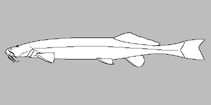
Body shape (shape guide): elongated.
Found in places with mud and roots of aquatic plants of a small stream, mainly composed of sandbanks (Ref. 116750).
Cycle de vie et comportement reproducteur
Maturité | Reproduction | Frai | Œufs | Fécondité | Larves
Henschel, E., J.L.O. Mattos, A.M. Katz and W.J.E.M. Costa, 2018. Position of enigmatic miniature trichomycterid catfishes inferred from molecular data (Siluriformes). Zoologica Scripta 2017:1-10. (Ref. 116750)
Statut dans la liste rouge de l'IUCN (Ref. 130435: Version 2025-2 (Global))
Menace pour l'homme
Harmless
Utilisations par l'homme
Pêcheries: sans intérêt
Outils
Articles particuliers
Télécharger en XML
Sources Internet
Estimations basées sur des modèles
Indice de diversité phylogénétique (Réf.
82804): PD
50 = 0.5625 [Uniqueness, from 0.5 = low to 2.0 = high].
Bayesian length-weight: a=0.00389 (0.00180 - 0.00842), b=3.12 (2.94 - 3.30), in cm total length, based on all LWR estimates for this body shape (Ref.
93245).
Niveau trophique (Réf.
69278): 3.0 ±0.3 se; based on size and trophs of closest relatives
Vulnérabilité de la pêche (Ref.
59153): Low vulnerability (10 of 100).
🛈