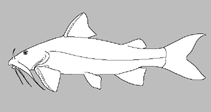
Classification / Noms
Noms communs | Synonymes | Catalog of Fishes(Genre, Espèce) | ITIS | CoL | WoRMS | Cloffa
>
Siluriformes (Catfishes) >
Sisoridae (Sisorid catfishes) > Sisorinae
Etymology: Glyptothorax: Greek, glyptes = carver + Greek, thorax = breast (Ref. 45335); maceriatus: From the Latin adjective maceriatus (masculine), meaning enclosed or walled in, in reference to the narrowly elliptic central depression in the thoracic adhesive apparatus being almost completely enclosed by skin ridges.
Environnement : milieu / zone climatique / profondeur / gamme de distribution
Écologie
; eau douce démersal. Tropical
Asia: Mausam, Sur Luite (both tributaries of the Tuivai River), Tlawng and Tuirial
rivers in Mizoram, India.
Taille / Poids / Âge
Maturité: Lm ? range ? - ? cm
Max length : 11.1 cm SL mâle / non sexé; (Ref. 97352)
Description synthétique
Clés d'identification | Morphologie | Morphométrie
Épines dorsales (Total) : 1; Rayons mous dorsaux (Total) : 6; Rayons mous anaux: 11 - 13; Vertèbres: 35 - 37. It is distinguished from other species of Glyptothorax from rivers draining the Ganges Delta in having a combination of the following characters: nasal barbel not reaching anterior orbita margin; interorbital distance 27.0-31.4% HL; head length 23.7-25.3% SL; head depth 12.5-14.2 % SL; thoracic adhesive apparatus with narrow elliptic central depression that is almost wholly enclosed posteriorly by skin ridges (striae) and with single, non-diverging series of striae running along its edges; width of adhesive apparatus 55.8-72.1% its length; unculiferous ridges of adhesive apparatus not extending anteriorly onto gular region; absence of striae on first pectoral- and pelvic-fin elements; pectoral-fin length 20.7-24.9% SL; smooth posterior
edge of dorsal spine; dorsal-to-adipose distance 17.8-23.6% SL; body depth at anus 11.3-13.8% SL; pelvic-fin length 15.9-19.1% SL; length of anal-fin base 13.9-16.2% SL; caudal peduncle length 21.4-23.9% SL; and caudal peduncle depth 6.4-7.6% SL (3.1-3.4 times in its length). In addition to these characters, it differs from congeners in the Kaladan River drainage in eastern Mizoram by its dorsal-spine length 13.0-17.1% SL (Ref. 91243).
Body shape (shape guide): elongated.
Inhabits clear, shallow, moderately flowing streams with a predominantly sandy bottom. Lives in association with Garra spp. (Cyprinidae), Balitora cf. brucei (Balitoridae), Botia cf. almorhae (Botiidae), Lepidocephalichthys sp. (Cobitidae), Schistura spp. (Nemacheilidae), Amblyceps laticeps (Amblycipitidae), Glyptothorax botius (Sisoridae), G. telchitta (Sisoridae), and Channa sp. (Channidae) (Ref. 91243).
Cycle de vie et comportement reproducteur
Maturité | Reproduction | Frai | Œufs | Fécondité | Larves
Ng, H.H. and Lalramliana, 2012. Glyptothorax maceriatus, a new species of sisorid catfish (Actinopterygii: Siluriformes) from north-eastern India. Zootaxa 3416:44-52. (Ref. 91243)
Statut dans la liste rouge de l'IUCN (Ref. 130435: Version 2025-2 (Global))
Menace pour l'homme
Harmless
Utilisations par l'homme
Pêcheries: sans intérêt
Outils
Articles particuliers
Télécharger en XML
Sources Internet
Estimations basées sur des modèles
Indice de diversité phylogénétique (Réf.
82804): PD
50 = 0.5000 [Uniqueness, from 0.5 = low to 2.0 = high].
Bayesian length-weight: a=0.00794 (0.00365 - 0.01726), b=3.02 (2.85 - 3.19), in cm total length, based on LWR estimates for this Genus-body shape (Ref.
93245).
Niveau trophique (Réf.
69278): 3.2 ±0.4 se; based on size and trophs of closest relatives
Résilience (Réf.
120179): Milieu, temps minimum de doublement de population : 1,4 à 4,4 années (Preliminary K or Fecundity.).
Vulnérabilité de la pêche (Ref.
59153): Low vulnerability (10 of 100).
🛈