Klassifizierung / Names
Namen | Synonyme | Catalog of Fishes(Gattung, Arten) | ITIS | CoL | WoRMS | Cloffa
>
Eupercaria/misc (Various families in series Eupercaria) >
Labridae (Wrasses) > Julidinae
Etymology: Coris: Greek, kore, -es = pupil and also with themenaing of "maid" (Ref. 45335); latifasciata: Name from the Latin, referring to the broad dark bars dorsally on the body (Ref. 93522).
Umwelt: Milieu / Klimazone / Tiefenbereich / Verbreitungsgebiet
Ökologie
seewasser riff-verbunden; tiefenbereich 10 - 28 m (Ref. 93522). Tropical
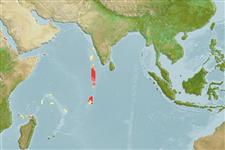
Indian Ocean: Maldive Islands and Chagos Archipelago.
Größe / Gewicht / Alter
Geschlechtsreife: Lm ? range ? - ? cm
Max length : 9.4 cm SL Männchen/unbestimmt; (Ref. 93522)
Kurzbeschreibung
Bestimmungsschlüssel | Morphologie | Morphometrie
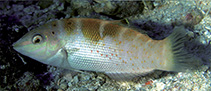
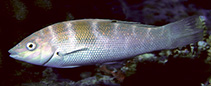
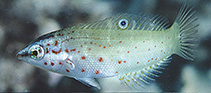
Rückenflossenstacheln (insgesamt) : 9; Rückenflossenweichstrahlen (insgesamt) : 11; Afterflossenstacheln: 3; Afterflossenweichstrahlen: 11. This species is distinguished by the following characters: D IX,11; A III,11; pectoral rays 14 (rarely 15); lateral-line scales 50-52 (+1); scaleless head; gill rakers 19-22; a pair of large, strongly projecting, slightly recurved canine teeth anteriorly in each jaw, the upper pair slightly out-flaring, the lowers fitting between uppers when mouth closed; body depth 3.25-3.55 in SL; caudal fin truncate to slightly rounded; short pelvic fins, 1.4-1.6 in head length; body colour of adults pale blue to blue-green, the scale centers whitish, especially on abdomen, 6 dusky orange bars dorsally on body, much broader than whitish interspaces, 2 small bars on nape; broadest bar below fourth to eighth dorsal spines, curving posteriorly in its lower part; head pale green with oblique pink bands; an ocellated black spot between first and second soft rays of dorsal fin; a black spot at upper base of pectoral fin, continuing as a narrowing line across base; juveniles light blue-green with scattered small red spots, larger and more numerous on postorbital head and anterior body; a second smaller ocellus posteriorly in dorsal fin; a blackish stripe on side of snout (Ref. 93522).
Body shape (shape guide): fusiform / normal; Cross section: oval.
Lebenszyklus und Paarungsverhalten
Geschlechtsreife | Fortpflanzung | Ablaichen | Eier | Fruchtbarkeit | Larven
Oviparous, with distinct pairing during breeding (Ref. 205).
Randall, J.E., 2013. Seven new species of labrid fishes (Coris, Iniistius, Macropharyngodon, Novaculops, and Pteragogus) from the Western Indian Ocean. J. Ocean Sci. Found. 7:1-43. (Ref. 93522)
IUCN Rote Liste Status (Ref. 130435: Version 2025-2 (Global))
Bedrohung für Menschen
Harmless
Nutzung durch Menschen
Fischereien: kleinfischerei
Tools
Zusatzinformationen
Download XML
Internet Quellen
Schätzungen auf der Grundlage von Modellen
Bevorzugte Temperatur (Ref.
123201): 27.4 - 28.1, mean 27.8 °C (based on 6 cells).
Phylogenetischer Diversitätsindex (Ref.
82804): PD
50 = 0.5000 [Uniqueness, from 0.5 = low to 2.0 = high].
Bayesian length-weight: a=0.00977 (0.00468 - 0.02039), b=3.07 (2.90 - 3.24), in cm total length, based on LWR estimates for this (Sub)family-body shape (Ref.
93245).
Trophische Ebene (Ref.
69278): 3.3 ±0.3 se; based on size and trophs of closest relatives
Widerstandsfähigkeit (Ref.
120179): hoch, Verdopplung der Population dauert weniger als 15 Monate. (Preliminary K or Fecundity.).
Anfälligkeit der Fischerei (Ref.
59153): Low vulnerability (10 of 100).
🛈