klasifikasi / Nama
Nama-nama umum | Sinonim (persamaan) | Catalog of Fishes(Marga, Jenis) | ITIS | CoL | WoRMS | Cloffa
>
Eupercaria/misc (Various families in series Eupercaria) >
Labridae (Wrasses) > Cirrhilabrinae
Etymology: Pteragogus: Greek, pteron = wing, fin + Greek, ago = to drive (Ref. 45335); trispilus: Named trispilus from the Latin for the three black spots anteriorly on the dorsal fin, one on each of the first three membranes (Ref. 93522).
Lingkungan: lingkungan / zona iklim / kisaran kedalaman / jangkauan distribusi
Ekologi
laut berasosiasi dengan karang; kisaran kedalaman 9 - 35 m (Ref. 93522). Subtropical
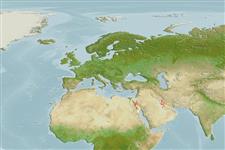
Western Indian Ocean: Red Sea: Gulf of Aqaba and Gulf of Suez. Mediterranean Sea: Lessepsian migrant to the eastern Mediterranean Sea, primarily as Pteragogus pelycus.
Ukuran / Berat / umur
Kematangan: Lm ? range ? - ? cm
Max length : 7.9 cm SL jantan/; (Ref. 93522)
deskripsi pendek
Kunci identifiaksi (pengenalan) | Morfologi | Morfometrik
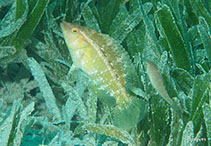
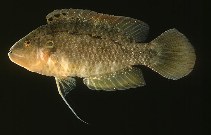
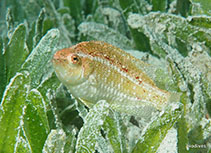
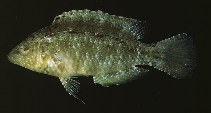
Duri punggung (Keseluruhan (total)) : 11; duri punggung lunak (Keseluruhan (total)) : 9; Duri dubur: 3; Sirip dubur lunak: 9; vertebrata, bertulang belakang: 25. This species is distinguished by the following characters: D XI,9; A III,9; pectoral rays 13 (rarely 12); complete lateral line, angling sharply downward below soft part of anal fin to straight peduncular part; pored scales 24 (plus 2 on base of caudal fin, the last greatly enlarged); body moderately deep, depth 2.75-2.95 in SL; head length 2.7 in SL; dorsal profile of head straight in adult female, with adult male, a very a slight concavity above eye; interorbital convex; orbit diameter 4.15-5.4 in head length; straight part of posterior margin of preopercle serrate, the serrae varying from 14 on 27-mm paratype to 23 on 73-mm holotype; no long filaments extending from tips of dorsal spines; caudal fin rounded and moderately long, 2.7-3.1 in SL; very long first soft ray of pelvic fins, 2.0-3.3 in SL. Color when fresh olivaceous, scale edges dotted with white, an oblique elliptical black spot on opercle, broadly rimmed in yellow, a vertical white streak to each side of posterior edge of preopercle, scattered small black spots behind eye and on nape, pupil rimmed with orange, the rest of iris with 7 spoke-like dark lines, lateral line with black dots and dashes and white dots, median fins olivaceous with white dots on rays and oblique white lines on spinous portion ventral part of head and posterior opercle of male suffused with orange, females may have a whitish stripe from front of snout and broadening to pupil depth as it passes posteriorly on body below lateral line to upper base of caudal fin, longitudinal rows of white spots may be present on body ventral to pectoral-fin base, as well as faint orange spots; alcohol-preserved, yellowish brown with faint dark spots and dashes along anterior part of lateral line, fins translucent yellowish with a black spot on each of first three spinous membranes of dorsal fin of males (half size on third membrane), 2 spots on adult females (sometimes as faint small spot on third membrane) (Ref. 93522).
Body shape (shape guide): short and / or deep; Cross section: compressed.
Collected with rotenone or spear in areas with sand bottom with detached brown algae or small coral patches and rocks. A very cryptic species, hence difficult to photograph underwater. The small sample of stomach contents from the holotype contained foraminiferans and from the 7.35 cm paratype consisted mainly of crushed remains of small gastropods, some foraminiferans, and unidentified crustacean fragments, including a small crab chela. Also from the very large stomach of the 4.4 cm paratype, it was found to contain the remains of a moderately large shrimp, so this fish does not feed exclusively on tiny prey (Ref. 93522). Maximum depth reported taken from Ref. 127989.
Siklus hidup dan perilaku kawin
Kematangan | Reproduksi, perkembang biakan | Pemijahan | telur-telur | Fekunditas | Larva
Oviparous, distinct pairing during breeding (Ref. 205).
Randall, J.E., 2013. Seven new species of labrid fishes (Coris, Iniistius, Macropharyngodon, Novaculops, and Pteragogus) from the Western Indian Ocean. J. Ocean Sci. Found. 7:1-43. (Ref. 93522)
Status IUCN Red List (Ref. 130435: Version 2025-2 (Global))
ancaman kepada manusia
Harmless
penggunaan manusia
Perikanan: tidak ada kepentingan
Alat, peralatan
laporan khas
muat turun XML
Sumber internet
Estimasi berdasarkan model
Suhu yang disukai (Acuan
123201): 22.2 - 27.2, mean 25.1 °C (based on 48 cells).
Indeks keanekaragaman filogenetik (Acuan
82804): PD
50 = 0.5005 [Uniqueness, from 0.5 = low to 2.0 = high].
Bayesian length-weight: a=0.01995 (0.00906 - 0.04395), b=3.01 (2.83 - 3.19), in cm total length, based on all LWR estimates for this body shape (Ref.
93245).
Tingkat Trofik (Acuan
69278): 3.4 ±0.4 se; based on size and trophs of closest relatives
Daya lenting (Acuan
120179): Tinggi, Waktu penggandaan populasi minimum kurang dari 15 bulan (Preliminary K or Fecundity.).
Kerentanan Penangkapan Ikan (Ref.
59153): Low vulnerability (10 of 100).
🛈