Classification / Noms
Noms communs | Synonymes | Catalog of Fishes(Genre, Espèce) | ITIS | CoL | WoRMS | Cloffa
>
Characiformes (Characins) >
Lebiasinidae (Pencilfishes) > Pyrrhulininae
Etymology: Pyrrhulina: Greek, pyrrhos = red, with the colour of the fire (Ref. 45335); marilynae: The specific epithet is in honor to Marilyn Weitzman, for her assistance to both authors since the beginning of their enterprise in studying fishes of the family Lebiasinidae. A noun (Ref. 93568).
Eponymy: Mrs Marilyn Jean Weitzman née Sohner (d: 1926) is a Research Associate at the Smithsonian, where she has devoted her career to the study of fishes of the Lebiasinidae and Characidae families. [...] (Ref. 128868), visit book page.
Environnement : milieu / zone climatique / profondeur / gamme de distribution
Écologie
; eau douce pélagique. Tropical; 11°S - 13°S, 55°W - 57°W
South America: Brazil. Pyrrhulina marilynae is known from the headwaters of the rio Tapajós and rio Xingu in the Brazilian Shield (Ref. 93568).
Taille / Poids / Âge
Maturité: Lm ? range ? - ? cm
Max length : 3.0 cm SL mâle / non sexé; (Ref. 93568)
Description synthétique
Clés d'identification | Morphologie | Morphométrie
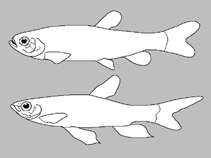
Pyrrhulina marilynae differs from all congeners (except Pyrrhulina zigzag) by presenting a conspicuous, dark primary stripe extending from tip of snout to middle caudal-fin rays, with a zigzag pattern along most body length (vs. primary stripe straight and narrow, mostly restricted to the head or not extending posterior to vertical through anal fin origin). Pyrrhulina marilynae differs from P. zigzag by the presence of a distinct, clear zigzag area lying between the primary stripe and the strongly pigmented dorsum; the lack of a hiatus on the primary stripe; and the absence of elongate dorsal-, anal- and caudal-fin rays in males (vs. clear zigzag area absent, and dorsum poorly pigmented; presence of a hiatus on the primary stripe at approximately fifth scale of fourth longitudinal series; rays of dorsal, anal and caudal-fin upper lobe distinctly elongate in males). The new species further differs from all congeners (except P. australis) by presenting nine principal rays on caudal-fin dorsal lobe, and 18 or less precaudal vertebrae (vs. 10 principal rays on caudal-fin dorsal lobe and 19 or more precaudal vertebrae). It can be further distinguished from P. australis by the absence of the posthcleithrum 2 (vs. postcleithrum 2 present). Pyrrhulina marilynae differs from all congeners (except Pyrrhulina zigzag) by presenting a conspicuous, dark primary stripe extending from tip of snout to middle caudal-fin rays, with a zigzag pattern along most body length (vs. primary stripe straight and narrow, mostly restricted to the head or not extending posterior to vertical through anal fin origin). Pyrrhulina marilynae differs from P. zigzag by the presence of a distinct, clear zigzag area lying between the primary stripe and the strongly pigmented dorsum; the lack of a hiatus on the primary stripe; and the absence of elongate dorsal-, anal- and caudal-fin rays in males (vs. clear zigzag area absent, and dorsum poorly pigmented; presence of a hiatus on the primary stripe at approximately fifth scale of fourth longitudinal series; rays of dorsal, anal and caudal-fin upper lobe distinctly elongate in males). The new species further differs from all congeners (except P. australis) by presenting nine principal rays on caudal-fin dorsal lobe, and 18 or less precaudal vertebrae (vs. 10 principal rays on caudal-fin dorsal lobe and 19 or more precaudal vertebrae). It can be further distinguished from P. australis by the absence of the posthcleithrum 2 (vs. postcleithrum 2 present) (Ref. 93568).
Body shape (shape guide): elongated; Cross section: oval.
Cycle de vie et comportement reproducteur
Maturité | Reproduction | Frai | Œufs | Fécondité | Larves
Netto-Ferreira, A.L. and M.M.F. Marinho, 2013. New species of Pyrrhulina (Ostariophysi: Characiformes: Lebiasinidae) from the Brazilian Shield, with comments on a putative monophyletic group of species in the genus. Zootaxa 3664(3):369-376. (Ref. 93568)
Statut dans la liste rouge de l'IUCN (Ref. 130435: Version 2025-2 (Global))
Menace pour l'homme
Harmless
Utilisations par l'homme
Pêcheries: d'intérêt potentiel
Outils
Articles particuliers
Télécharger en XML
Sources Internet
Estimations basées sur des modèles
Indice de diversité phylogénétique (Réf.
82804): PD
50 = 0.5000 [Uniqueness, from 0.5 = low to 2.0 = high].
Bayesian length-weight: a=0.00646 (0.00280 - 0.01488), b=3.13 (2.93 - 3.33), in cm total length, based on LWR estimates for this (Sub)family-body shape (Ref.
93245).
Niveau trophique (Réf.
69278): 3.1 ±0.4 se; based on size and trophs of closest relatives
Vulnérabilité de la pêche (Ref.
59153): Low vulnerability (10 of 100).
🛈