>
Gobiiformes (Gobies) >
Gobiidae (Gobies) > Gobiinae
Etymology: Ctenogobiops: Greek, kteis, ktenos = comb + Latin, gobius = gudgeon + Greek, ops = appearance (Ref. 45335).
Milieu: milieu / Klimaatzone / Diepte / verspreidingsgebied
Ecologie
marien rifbewoner; diepte 1 - 15 m (Ref. 90102). Tropical
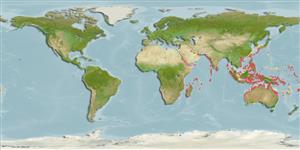
Indo-Pacific: widespread, from the Red Sea to the western Pacific, with records from the Great Barrier Reef and the Ryukyu Islands.
Grootte / Gewicht / Leeftijd
Maturiteit: Lm ? range ? - ? cm
Max length : 5.5 cm SL mannelijk / geslacht onbekend; (Ref. 90180)
Korte beschrijving
Determinatiesleutels | Morfologie | Morfometrie
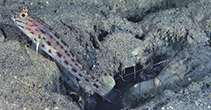
Dorsale stekels (totaal) : 7; Dorsale zachte stralen (totaal) : 11 - 12; Anale stekels: 1; Anale zachte stralen: 11. This species is distinguished by the following characters: D VI + I,11-12; A I,11; pectoral rays 19; longitudinal scale series 55-60; body depth 4.8-5.2 in SL; head length (HL) 3.1-3.3 in SL; dorsal profile of snout forming an angle of about 40° to horizontal axis of head and body; wide gill opening, reaching forward nearly to a vertical at posterior edge of eye; 2nd dorsal spine equal to or slightly longer than first spine and longer than the third spine, and about equal to the body depth (0.9-1.1); rounded caudal fin, 1.1-1.3 in HL; body with 4 longitudinal rows of dark brown spots, the 1st and 3rd as thick dashes, the spots of second row much smaller, except large first one over upper end of gill opening; 4th row ventrally on body with 2 or 3 spots on abdomen approaching pupil size, remaining spots only dark flecks; postorbital head with 3 oblique rows of dark dashes at an angle less than 45°, the 1st a single long dash behind eye, the next 2 across cheek, ending on upper half of opercle; 4 oblique rows of dark brown dashes and dots from eye across lips; median, dark brown, V-shaped mark dorsally on snout absent; in life, no small yellow flecks ventrally on body; larger dark spots on ventral half of body often encircled with blue dots; pectoral fins with a small white dash at upper base, a long white streak from base, narrowing into middle of fin (Ref. 90180).
Body shape (shape guide): elongated; Cross section: oval.
Levenscyclus en paargedrag
Maturiteit | Voortplanting | Paaien | Eieren | Fecunditeit | Larven
Kovačić, M., S.V. Bogorodsky and J.E. Randall, 2011. Redescription of the Red Sea gobiid fish Ctenogobiops maculosus (Fourmanoir) and validation of C. crocineus Smith. Zootaxa 3054:60-68. (Ref. 90180)
Status op de Rode Lijst van het IUCN (Ref. 130435: Version 2025-2 (Global))
Gevaar voor de mens
Harmless
Gebruik door de mens
Tools
Speciale rapporten
Download XML
Internetbronnen
Schattingen op basis van modellen
Gewenste temperatuur (Ref.
123201): 24.7 - 29.3, mean 28.4 °C (based on 2743 cells).
Fylogenetische diversiteitsindex (Ref.
82804): PD
50 = 0.5020 [Uniqueness, from 0.5 = low to 2.0 = high].
Bayesian length-weight: a=0.00741 (0.00347 - 0.01582), b=3.09 (2.91 - 3.27), in cm total length, based on LWR estimates for this (Sub)family-body shape (Ref.
93245).
Trofisch niveau (Ref.
69278): 3.5 ±0.45 se; based on food items.
Weerstandsvermogen (Ref.
120179): Hoog, minimale populatieverdubbelingstijd minder dan 15 maanden (Preliminary K or Fecundity.).
Kwetsbaarheid van de visserij (Ref.
59153): Low vulnerability (10 of 100).
🛈
Voedingsstoffen (Ref.
124155): Calcium = 210 [94, 456] mg/100g; Iron = 0.931 [0.460, 1.868] mg/100g; Protein = 18 [16, 20] %; Omega3 = 0.0994 [, ] g/100g; Selenium = 21 [8, 52] μg/100g; VitaminA = 157 [42, 562] μg/100g; Zinc = 2.4 [1.5, 3.7] mg/100g (wet weight);