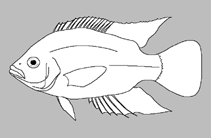
>
Cichliformes (Cichlids, convict blennies) >
Cichlidae (Cichlids) > Pseudocrenilabrinae
Etymology: Chetia: Moçambique local name.
Environnement : milieu / zone climatique / profondeur / gamme de distribution
Écologie
; eau douce benthopélagique. Subtropical; 23°S - 25°S
Africa: Komati-Incomati River system, eastern Transvaal, South Africa and coastal lakes in Mozambique. Population threatened by pollution and water extraction. Translocated to dams in the Kruger National Park (Ref. 7248).
Taille / Poids / Âge
Maturité: Lm ? range ? - ? cm
Max length : 15.0 cm SL mâle / non sexé; (Ref. 4983)
Description synthétique
Clés d'identification | Morphologie | Morphométrie
Occurs mainly in pools and quiet stretches of rivers with sandy substrates and dense marginal vegetation. Feeds on small fish and aquatic insects (Ref. 6465). Agamous, ovophilic (Ref. 52307) maternal mouthbrooder (Ref. 7248, 52307), the female carries the eggs and larvae (Ref. 7248).
Cycle de vie et comportement reproducteur
Maturité | Reproduction | Frai | Œufs | Fécondité | Larves
Female incubates eggs and larvae in the mouth (Ref. 27553).
van Oijen, M.J.P., J. Snoeks, P.H. Skelton, C. Maréchal and G.G. Teugels, 1991. Haplochromis. p. 100-184. In J. Daget, J.-P. Gosse, G.G. Teugels and D.F.E. Thys van den Audenaerde (eds.) Check-list of the freshwater fishes of Africa (CLOFFA). ISNB, Brussels; MRAC, Tervuren; and ORSTOM, Paris. Vol. 4. (Ref. 4983)
Statut dans la liste rouge de l'IUCN (Ref. 130435: Version 2025-2 (Global))
Menacé (EN) (A4ace; B1ab(iii,v)+2ab(iii,v)); Date assessed: 07 December 2016
Menace pour l'homme
Harmless
Utilisations par l'homme
Outils
Articles particuliers
Télécharger en XML
Sources Internet
Estimations basées sur des modèles
Indice de diversité phylogénétique (Réf.
82804): PD
50 = 0.5156 [Uniqueness, from 0.5 = low to 2.0 = high].
Bayesian length-weight: a=0.01445 (0.00671 - 0.03113), b=2.99 (2.82 - 3.16), in cm total length, based on LWR estimates for this (Sub)family-body shape (Ref.
93245).
Niveau trophique (Réf.
69278): 3.8 ±0.61 se; based on food items.
Résilience (Réf.
120179): Milieu, temps minimum de doublement de population : 1,4 à 4,4 années (Assuming Fec<1000).
Vulnérabilité de la pêche (Ref.
59153): Low vulnerability (10 of 100).
🛈