Classification / Noms
Noms communs | Synonymes | Catalog of Fishes(Genre, Espèce) | ITIS | CoL | WoRMS | Cloffa
>
Siluriformes (Catfishes) >
Sisoridae (Sisorid catfishes) > Sisorinae
Etymology: Glyptothorax: Greek, glyptes = carver + Greek, thorax = breast (Ref. 45335); igniculus: From the Latin noun igniculus, meaning a little flame, in allusion to the lanceolate, flame-shaped central depression in the thoracic adhesive apparatus that is nearly completely enclosed by skin ridges caudally.
Environnement : milieu / zone climatique / profondeur / gamme de distribution
Écologie
; eau douce démersal. Tropical
Asia: Myittha River, a tributary of the Chindwin River in Myanmar.
Taille / Poids / Âge
Maturité: Lm ? range ? - ? cm
Max length : 7.1 cm SL mâle / non sexé; (Ref. 93787)
Description synthétique
Clés d'identification | Morphologie | Morphométrie
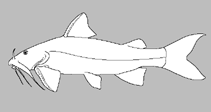
Rayons mous dorsaux (Total) : 7; Rayons mous anaux: 12 - 13; Vertèbres: 35 - 36. Can be diagnosed from other species of Glyptothorax in the Irrawaddy River drainage by its thoracic adhesive apparatus, in which the central depression is almost completely enclosed posteriorly by the skin ridges that make up the apparatus, instead of open caudally or, in G. burmanicus, completely closed. Further differs from G. burmanicus in having a larger eye (diameter 10.4-12.7% HL vs. 6.3-10.0), a longer dorsal-fin spine (16.9-21.6% SL vs. 11.9-14.7), and shorter prepectoral (17.1-21.7% SL vs. 22.3-25.4) and prepelvic lengths (47.0-51.3% SL vs. 52.8-59.4). Distinguished from other congeners by having the following combination of diagnostic characters: dorsal-fin spine length 16.9-21.6% SL; dorsal-to-adipose distance 19.8-24.6% SL; body depth at anus 15.2-16.4% SL; caudal peduncle depth 8.2-9.7% SL; total vertebrae 35-36; head width 20.3-21.8% SL; rounded tubercles on the dorsal surface of the head; almost uniform body; nasal barbel length 30.1-35.5% HL; lack ridges of the thoracic adhesive apparatus extending onto the gular region; head length 25.3-28.2% SL; predorsal distance 35.6-37.4% SL; postadipose distance 18.8-20.8% SL; and adipose-fin base length 13.9-15.8% SL; the depressed central in the thoracic adhesive apparatus lanceolate; with a single, non-diverging series of striae running along its edges; anal-fin base length 14.1-17.8% SL; pectoral-fin length 21.2-26.1% SL; lacking plicae on the ventral surfaces of the first pectoral- and pelvic-fin elements; and lacking both a distinct pale midlateral stripe on the body and distinct dark submarginal stripe along each lobe of the caudal fin (Ref. 93787).
Body shape (shape guide): elongated.
Found in a wide (ca. 200 m), turbid river with moderate current and a substrate composed of clay (Ref. 93787).
Cycle de vie et comportement reproducteur
Maturité | Reproduction | Frai | Œufs | Fécondité | Larves
Ng, H.H. and S.O. Kullander, 2013. Glyptothorax igniculus, a new species of sisorid catfish (Teleostei: Siluriformes) from Myanmar. Zootaxa 3681(5):552-562. (Ref. 93787)
Statut dans la liste rouge de l'IUCN (Ref. 130435: Version 2025-2 (Global))
Menace pour l'homme
Harmless
Utilisations par l'homme
Pêcheries: sans intérêt
Outils
Fatal error: Uncaught mysqli_sql_exception: Too many connections in /var/www/html/includes/speciessummary.lib.php:1888
Stack trace:
#0 /var/www/html/includes/speciessummary.lib.php(1888): mysqli->__construct('mysql', 'fbuser', Object(SensitiveParameterValue), 'fbquizv2', '3306')
#1 /var/www/html/summary/SpeciesSummary.php(1851): checkRecordDisplayFBQuizV2('67047', 'PicList')
#2 {main}
thrown in /var/www/html/includes/speciessummary.lib.php on line 1888